Stitch & Selvage earns a commission when you buy through the links on this page, at no extra cost to you. It does not change what we recommend, and we publish a skip-this verdict on products we could otherwise earn from. Full disclosure.
A drop-in bobbin sits horizontally under a clear lid beside the needle: lift, drop it in, pull the thread through a slot, close. A front-loading bobbin sits vertically in a removable case that must come out, be loaded in a specific direction, be threaded under a tension spring and be re-seated until it clicks. Both make identical stitches. One has roughly twice as many ways to go wrong.
The ranking
Quick picks
Ranked against the published criteria below. Tap a row to jump to the full write-up; the price button goes straight to Amazon.
The cheapest machine that threads itself
Brother GX37 Sewing Machine
An automatic needle threader, a one-step buttonhole and a drop-in bobbin at Brother's lower end, on a 10.14 lb machine that ships with its own dust cover — the three convenience features that decide a beginner's first month, without the price of a computerized model.
The GX37 is the machine that answers a narrow question very well: what is the cheapest Brother that still threads its own needle? Brother's specification lists the needle threading system as automatic and the buttonhole as an automatic one-step, on a machine it lists at $149.99. At the XM1010's $139.99 the threading system is manual, and that ten-dollar gap buys the feature we would protect first.
The rest of the specification is a competent mechanical machine and nothing surprising: 37 utility and decorative stitches selected on a dial, a jam-resistant quick-set drop-in top bobbin, a free arm for cuffs and sleeves, and an LED-lit work area. Brother lists six presser feet — zigzag, buttonhole, zipper, button sewing, blind stitch and narrow hemmer — which covers ordinary garment sewing and stops there.
Two things make it unusually well suited to a young or first-time sewer specifically. It weighs 10.14 lb, which is the lightest figure Brother publishes across the machines we cover, so it can be lifted onto a table and put away by someone small. And Brother includes a dust cover, which sounds trivial until you notice that the XM2701, the LX3817 and the SINGER M1500 all ship without one and a machine stored uncovered collects the lint that later causes tension problems.
What it does not have is a speed limiter. Brother publishes adjustable sewing speed control on the CS7000X and does not list it here, so on this machine the foot pedal is the only thing standing between a nervous beginner and full speed. That is manageable with a bit of practice on scrap and it is the one specification we would trade up for if the budget allowed.
We have not sewn on this machine. Every figure above is from Brother's own product page, read on 3 September 2026, and the price on the button is live from Amazon rather than remembered.
What works
- Automatic needle threading at the bottom of the range — the single feature we would least willingly give up, and one the similarly-priced XM1010 does not have
- A one-step buttonhole rather than a four-step one, which is the difference between placing a button and pressing, and turning a dial through four positions by eye
- Quick-set drop-in top bobbin, so loading it is a lid and a drop
- A dust cover is included — the Brother XM2701, LX3817 and SINGER M1500 all ship without one
- 10.14 lb, tied with the XR9550 as the lightest machine we cover
What does not
- Six presser feet, and none of them a walking foot or a quarter-inch foot
- Stitches are selected on a dial with no display, so the width and length you have actually set are not readable as numbers
- Brother does not publish an adjustable sewing speed control for it — the pedal is the only speed limiter
- 37 decorative stitches is more than a first year needs; you are choosing this machine for the threader, not the library
The kit it pairs with: Universal needles in 80/12 and 90/14, and more bobbins. The dust cover is already in the box, which is one line off the usual starter list.
The lowest-cost route to a working machine
SINGER M1500 Sewing Machine
Six built-in stitches, a four-step buttonhole and a front-loading bobbin: a genuinely basic machine that Singer prices accordingly and does not pretend otherwise.
Skip this one
The M1500 is the only front-loading machine we cover and it is here as the worked example, not as a recommendation for this comparison. It is a genuinely well-made machine for the money — 10 lb, pre-threaded out of the box, with a darning plate and an extra-high presser foot lifter. As a *first* machine we skip it, because it pairs the front-loading case with a four-step buttonhole and no listed automatic needle threader, and that is three obstacles arriving on the same evening.
There is a number on Singer's page for the M1500 that is easy to misread, so read it carefully: 6 built-in stitches, 57 stitch applications. Those are not the same thing. Singer defines a stitch application as a technique you can perform with a selected stitch — so a straight stitch used for seaming, basting, topstitching and edgestitching counts four times. The machine has six stitches. Brother's XM2701 has twenty-seven, for thirty dollars more.
The bobbin is the other thing to weigh. Singer lists this machine as front loading, taking a Class 15 transparent bobbin. A front-loading bobbin sits in a removable case under the needle plate: you take the case out, drop the bobbin in with the thread running the correct way, thread the tension slot, and put the case back. A drop-in bobbin, which every Brother machine on this site has, is a lid and a drop. For someone who has never done either, that is a real difference in how many attempts the first hour takes.
What Singer does give you at this price is genuinely worth having. It arrives pre-threaded, which sounds trivial and is not — the first thing that stops a new owner is an unthreaded machine and a manual. It includes a darning plate, which covers the feed teeth for free-motion work. It has an extra-high presser foot lifter for thick fabric, snap-on feet, and an LED light. Singer publishes the warranty as 90 day / 2 year / 25 year.
At 10 lb with a 13 x 7 x 11.5 inch footprint, this is the machine to buy if it has to live in a cupboard, come out for an hour, and go back. It is also the machine to buy if you genuinely are not sure you will stick with sewing and want the cheapest honest answer to that question.
We have not sewn on this machine. The specifications are Singer's own, published on its product page, and the price on the button is live from Amazon.
What works
- 10 lb, the lightest machine on this site — it can genuinely be carried to a class
- Ships pre-threaded, which removes the first obstacle a beginner hits
- An extra-high presser foot lifter, so thick fabric fits under the foot
- Includes a darning plate for free-motion work, which is unusual at this price
- Snap-on presser feet, so changing a foot is a click rather than a screwdriver
What does not
- Front-loading bobbin. You remove a case, seat the bobbin the right way round and re-seat the case — measurably harder than a drop-in
- Singer's specification does not list an automatic needle threader
- Six built-in stitches is the smallest library here; the 57 figure counts *applications* of those six, not additional stitches
- Four-step buttonhole
- 5.6 inches from needle to tower is the tightest throat here, which limits anything bulky
The kit it pairs with: Class 15 transparent bobbins, a needle threader tool, and a second pack of universal needles.
Not stopping mid-seam to wind another one
Class 15 transparent bobbins
Both Singer machines on this site take a Class 15 transparent bobbin, and three is not enough — a transparent bobbin also lets you see the thread running out before it does.
Start with the warning, because it is the one that costs people an evening: bobbin class is not universal, and a nearly-right bobbin is worse than no bobbin. A bobbin that is fractionally too tall, too wide or made of the wrong material will sit at a slight angle in the case, feed thread unevenly, and produce exactly the nest of loops underneath your fabric that people diagnose as a broken machine. Singer publishes the bobbin class for both machines on this site as Class 15 transparent, and recommends SINGER or INSPIRA branded bobbins for best results. Your manual states yours.
Assuming you have the right class, the reason to buy more is simple arithmetic. Brother ships three bobbins with the CS7000X, the XM2701 and the LX3817, and four with the XR9550. A single garment in two thread colors plus a basting color uses three. The moment you run out mid-seam you have to unthread the machine, wind a bobbin, and re-thread — and re-threading is where the next problem starts.
Transparent rather than metal, for a beginner, for one reason: you can see how much thread is left. Running the bobbin dry in the middle of a topstitch line is a specific kind of annoying, because the top thread keeps stitching and you do not notice until you turn the work over.
Wind one bobbin per color you use regularly and keep them on a bobbin ring. It is the cheapest quality-of-life improvement in this whole list.
What works
- Transparent, so you can see the thread level without unthreading the machine
- Cheap enough to wind one per thread color and stop re-winding
- Class 15 is the most widely used home bobbin class, so replacements are easy to find
What does not
- Bobbin class is not universal. Check your manual — the wrong class will seat badly and cause bunching, and some machines specify a plastic or a metal bobbin, not both
- Singer explicitly recommends its own or INSPIRA-branded bobbins for best results
- A cheap out-of-spec bobbin is a common cause of the tension problems people blame on their machine
Count the steps
The clearest way to see the difference is to write out what each one actually asks of you.
Drop-in, four steps
- Slide the clear cover off the bobbin compartment beside the needle.
- Drop the bobbin in so the thread comes off it in the direction printed on the machine — usually counter-clockwise.
- Pull the thread into the slot and along the guide groove.
- Replace the cover, leaving the thread tail out.
Front-loading, seven steps and two ways to feel it
- Open the flap or remove the accessory tray below the needle.
- Pull the bobbin case out by its hinged latch.
- Drop the bobbin into the case so the thread unwinds in the direction the manual shows.
- Pull the thread into the slot in the case.
- Draw it under the flat tension spring — you should feel slight resistance if it has seated.
- Hold the latch open and slide the case back onto its post.
- Release the latch and confirm it clicks home.
Neither is difficult once learned. But steps 3, 5 and 7 on the front-loading list each have a silent failure mode: the bobbin in backwards, the thread riding over the tension spring instead of under it, or the case not fully seated. None of them announces itself. All of them show up later as bad stitches.
Why the difference shows up as thread bunching
This is the part worth understanding, because it is the most common problem in home sewing and the most commonly misdiagnosed.
A stitch is two threads locking inside the fabric. The needle carries the top thread down, the hook catches the loop and wraps the bobbin thread through it, then the take-up lever rises and pulls the slack back so the lock sits in the middle of the cloth. Both threads need the correct tension for that lock to land in the right place.
On a front-loading machine, bobbin tension comes from that flat spring on the outside of the case. If the thread never went under it, the bobbin thread has effectively no tension, and you get loops on the top surface of the fabric. Re-seat the case wrong and the whole assembly sits at an angle and feeds unevenly.
What front-loading is genuinely better at
It is not a worse system, and it would be dishonest to present it as one. Two real advantages.
Adjustable bobbin tension. The screw on the side of a front-loading case lets you tune bobbin tension directly. That is a liability for a beginner — it is the screw people turn when they should be rethreading — and a genuine asset for anyone doing free-motion quilting or working with unusual threads, where top and bobbin tension need balancing independently.
Serviceability. The case comes out in one motion, which makes clearing a thread jam and cleaning the race straightforward. On a drop-in machine you are usually removing the needle plate to get the same access.
Which machines use which
Compiled from Brother USA and SINGER product specification pages, checked 1 and 6 September 2026.
Every Brother machine we cover is drop-in. Of the Singers, the Heavy Duty line is drop-in and the entry M1500 is front-loading. So in the beginner price range the choice is largely made for you by which machine you pick — it is not a feature you shop for independently.
The class matters more than the system
One warning that applies to both systems and catches more people than the drop-in versus front-loading question ever does: bobbins have a class, and a nearly-right bobbin is worse than no bobbin.
A bobbin fractionally too tall, too wide, or made of the wrong material sits at a slight angle, feeds thread unevenly, and produces exactly the symptoms people blame on the machine. Singer publishes Class 15 transparent for both machines we cover and specifically recommends SINGER or INSPIRA-branded bobbins for best results. Your manual states yours.
This is the main reason a bag of assorted bobbins from a bargain accessory kit is a false economy — and why that kit is our standing skip-this pick.
The verdict
For a first machine, prefer drop-in. Fewer steps, no silent failure modes, and you can see the thread supply without unthreading anything. It removes a category of problem that beginners cannot yet diagnose, and that is worth more than the tuning flexibility they are not ready to use.
Do not reject a machine solely because it is front-loading. If a front-loading machine wins on everything else that matters to you, the system is entirely learnable in an afternoon — and our threading walkthrough covers loading both types step by step.
Method
How we picked
- Put both sides' published manufacturer specifications side by side — Brother USA, SINGER and SCHMETZ pages, all checked 1 September 2026 — rather than comparing impressions.
- Resolved each dimension separately and said which side wins it, instead of averaging everything into a tie.
- Named a winner, and named the buyer the other option is right for.
- Priced live from Amazon. No number on this page is remembered.
We have not sewn on these machines. There is no test bench here, we do not own them, and we do not accept free product. Everything above is compiled from published manufacturer specifications and live retailer data — and we tell you which is which on every claim. Our full method.
Answers
Questions people ask
Is a drop-in bobbin better than a front-loading one?
Which sewing machines have a drop-in bobbin?
Why does my front-loading bobbin cause thread problems?
Can I use any bobbin in my machine?
Should I adjust the screw on my bobbin case?
Where this came from
Sources
- SINGER — M1500 specifications, front-loading bobbin and Class 15 guidance (checked 1 September 2026)
- SINGER — Heavy Duty 4423 specifications, top drop-in bobbin (checked 1 September 2026)
- Brother USA — CS7000X specifications, quick-set drop-in bobbin (checked 1 September 2026)
- Brother USA — XM1010 specifications, clear-view bobbin cover (checked 6 September 2026)
About the author
Scooter M.
An enthusiast who is genuinely into this. I read the manuals, compile the published specs, and do the arithmetic. No lab coat, no test bench, and no machines I am pretending to have used — which is exactly why every claim here carries a source.
Published by Slate Mill Group. Published September 6, 2026; last updated September 6, 2026. Editorial policy.
Keep reading
Read next
The bunching fix
Bobbin thread bunching up underneath
The nest of loops underneath is a top-thread fault. Four checks, in order, and the fix is free.
Bobbin winding
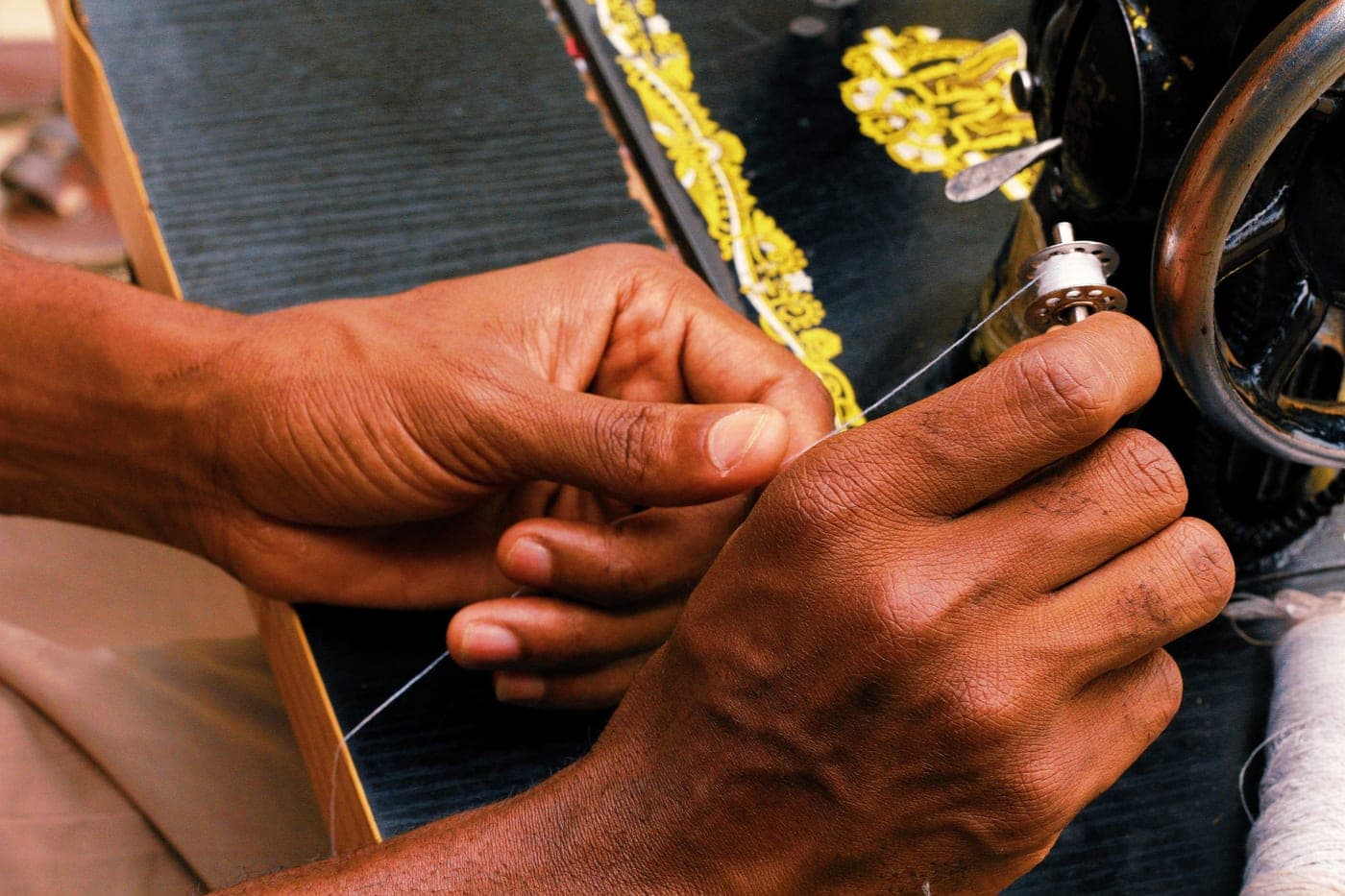
How to wind a bobbin
The separate winder tension disc everyone misses, and why a loose bobbin shows up as bad stitches later.
Brother vs Singer
Brother or Singer for a first sewing machine?
Bobbin type and needle threading settle it at the entry level — and Singer's own Heavy Duty machine is the exception.
Best overall
The best sewing machines for beginners
Six machines ranked on threading, bobbin, buttonhole and included feet — with the one we say not to buy first.