Stitch & Selvage earns a commission when you buy through the links on this page, at no extra cost to you. It does not change what we recommend, and we publish a skip-this verdict on products we could otherwise earn from. Full disclosure.
The Brother CS7000X is a computerized machine with 70 built-in stitches, an automatic needle threader and a quick-set drop-in bobbin. The reason to buy it is the box: Brother includes ten presser feet, among them a walking foot and a quarter-inch foot, which are the two accessories a beginner almost always ends up buying separately.
The ranking
Quick picks
Ranked against the published criteria below. Tap a row to jump to the full write-up; the price button goes straight to Amazon.
| # | Product | Best for | Score | Price |
|---|---|---|---|---|
| 1 | 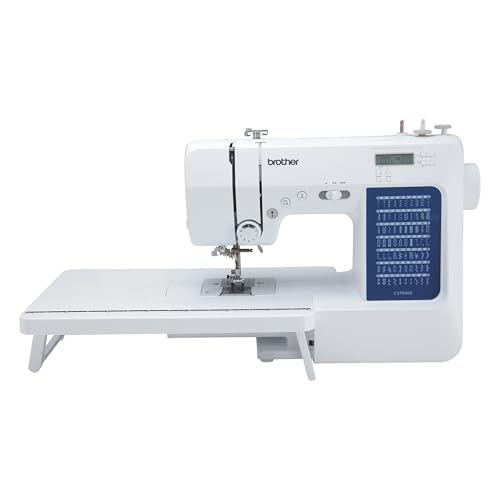 Brother CS7000X Computerized Sewing & Quilting Machine The first machine most beginners should buy | 70 built-in stitches | 9.2/10 |
The first machine most beginners should buy
Brother CS7000X Computerized Sewing & Quilting Machine
The only machine on this page that arrives with the two feet a beginner ends up buying anyway — a walking foot and a quarter-inch foot — plus an automatic needle threader and a drop-in bobbin, so the two jobs that make people quit are the two jobs it makes easy.
The CS7000X is the machine we point a first-time buyer at, and the reason has nothing to do with its stitch count. It is the presser feet. Brother lists ten of them in the box — zigzag, buttonhole, zipper, button sewing, overcasting, blind stitch, monogramming, quarter-inch, quilting and walking — plus a quilt guide. Two of those, the walking foot and the quarter-inch foot, are the exact accessories a beginner ends up ordering three months in, and they are not cheap bought separately.
The second reason is the threading. Brother's published specification lists an automatic needle threading system and a quick-set drop-in top bobbin. Threading the needle and setting the bobbin are the two jobs that make people put a machine back in its box, and this one turns both into a lever pull and a drop. On a front-loading machine you are removing a case, seating a bobbin in a particular orientation, and hoping.
It is a computerized machine, which means stitch selection is a mode key and a shift key against an LCD rather than a dial. That is a genuine trade-off, not a straight upgrade: a dial is legible at a glance and has nothing to fail, while an LCD tells you the stitch width and length the machine has actually selected. For someone learning, seeing the numbers is worth more than the simplicity of a dial.
The extras matter more than they sound. The detachable wide table turns a small free-arm machine into something you can push a quilt across, and the hard protective cover is the difference between a machine that stays out on a table and one that lives in a cupboard collecting dust. Brother also publishes a 25-year limited warranty and free phone and online technical support for the life of the product.
We have not sewn on this machine. Everything above is from Brother's own specification page, and the price on the button is live from Amazon rather than anything we typed. What we can tell you is what the box contains and what that saves you buying — which, for a first machine, is most of the decision.
What works
- Automatic needle threader and a drop-in bobbin — the two setup jobs that defeat most beginners
- Ten presser feet including the walking foot and a quilting foot, which the cheaper machines make you buy separately
- Detachable wide table and a hard cover are in the box, not extras
- Adjustable sewing speed control, so a first seam can be run slowly
- Brother publishes a 25-year limited warranty on it
What does not
- Seventy stitches is far more than a beginner will use; you are paying for decorative stitches you may never touch
- Computerized machines have more to go wrong electronically than a dial-and-lever mechanical
- At 10.5 lb it is light enough to walk across a table at speed unless it is on a firm surface
The kit it pairs with: It already includes the walking foot and quilting foot, so its starter kit is short: needles, bobbins, thread, shears and pins.
What Brother actually puts in the carton
This is the part of a specification sheet people skim, and on this machine it is the whole argument. The one machine that gets close for less is the mechanical XR3774, which also includes a walking foot, a quilting foot, a quilt guide and a wide table — it is missing the quarter-inch foot, the hard cover and the screen. And one machine beats it outright on carton contents: the CS7205 lists eleven feet, including the walking foot, the quarter-inch foot and a stitch guide foot, for ten dollars more on Brother's own list. The full Brother lineup is ranked here, with every list price read on one day. What it does not have is this machine's hard cover. Brother lists the carton as containing ten sewing feet — zigzag, buttonhole, zipper, button sewing, overcasting, blind stitch, monogramming, quarter-inch, quilting and walking — plus a quilt guide, an accessory pouch with a needle set, a ball point needle, a twin needle, a spool pin, three bobbins, a cleaning brush, a seam ripper, a screwdriver, an eyelet punch and an L driver. It also includes a detachable wide table and a hard protective cover.
Compare that with the computerized machine one tier down. Brother lists the CS5055 with seven feet and the same seven buttonhole styles as this machine, at a much lower list price — the two are compared in full here, and the answer turns entirely on whether you quilt. The machine one tier UP is the closer call: this machine against the CS7205 comes down to ten dollars, 135 stitches and an eleventh foot on one side against the hard cover on this one. Or compare it with the mechanical below that: Brother lists the XM2701 with six feet: buttonhole, zipper, zigzag, narrow hemmer, blind stitch and button sewing. No walking foot, no quarter-inch foot, no hard cover, no wide table. Those four items are the difference between the two prices, roughly, and they are all things you will want if you sew anything larger than a hem.
The two features that decide a first year
The automatic needle threader. Brother's specification lists the needle threading system as 'Automatic'. A small lever swings a hook through the needle eye, catches the thread and pulls it back. It sounds like a luxury and it is not: threading a needle by eye, under a machine arm, in the light most people sew in, is the point at which a lot of new owners decide sewing is not for them. The LX3817 does not have one, and that is the main thing separating the two machines in practice.
The quick-set drop-in bobbin. The bobbin sits under a clear lid to the left of the needle. You lift the lid, drop the bobbin in, run the thread through a slot and close it. There is no case to remove, no orientation to get wrong, and you can see how much thread is left without unthreading anything. Every Brother machine on this site uses this system. The SINGER M1500 uses a front-loading case instead, which is materially harder to get right the first ten times.
Where the seventy stitches actually go
Brother specifies 70 built-in stitches including seven styles of one-step, auto-size buttonhole. Be honest with yourself about that first number: in a first year you will use a straight stitch, a zigzag, a stretch stitch and a buttonhole. Sixty-something decorative stitches are not a reason to buy a machine.
The seven buttonhole styles are a different matter, because buttonholes are where garment sewing goes wrong. A one-step buttonhole means you drop the button into the back of the buttonhole foot, press the pedal and the machine sews a buttonhole sized to that button and stops. A four-step buttonhole — which is what the LX3817 and the M1500 have — means moving a dial through four positions in sequence for every buttonhole, and getting the lengths to match by eye.
The quilting case, and its one limitation
For a beginner who already knows they want to quilt, this is the machine on this site we would point at, for three published reasons: the walking foot is in the box, the quarter-inch foot is in the box, and the machine has drop feed for free-motion work. The detachable wide table is the fourth — a free-arm machine with no table means a quilt hangs off the edge and drags.
The limitation is throat space. This is a domestic machine with the arm length of a domestic machine, and no amount of walking foot changes what happens when you try to roll a queen-size quilt through it. For lap quilts, baby quilts, table runners and piecing, it is genuinely well equipped. For a full-size quilt, expect the wrestling that every domestic machine involves.
If you arrived here looking for a CS6000i
A lot of people do, because the CS6000i was the beginner machine the internet recommended for years and the CS7000X is where Brother's lineup continued. Brother now marks the CS6000i Discontinued with zero available units. The practical differences: this machine adds the quarter-inch piecing foot the CS6000i never included, sheds 2.5 lb (10.5 against 13), publishes a 25-year limited warranty against the CS6000i's 1 year, and runs slower — 750 stitches a minute against 850. The full migration is here.
The machine that undercuts it
One caveat we would rather raise ourselves than have you find later: Brother sells a machine whose published specification matches this one line for line and costs less. The CP100X has the same 750 stitches a minute, the same 7 mm stitch width, the same 10.5 lb weight in the same 12.2 x 6.65 x 16.26 inch shell, the same ten presser feet including the walking foot and quarter-inch foot, the same wide table, the same hard case and the same 25-year warranty — plus thirty more stitches and an eighth buttonhole style — for $259.99 against this machine's $279.99 on Brother's own list. If it is in stock, it is the better buy. The reason the CS7000X keeps our recommendation is that the CP100X's Amazon listing was unbuyable on three days we checked in September 2026, and the CS7000X's never has been.
What the specification does not tell you
We will not pretend otherwise: a specification cannot tell you how loud the motor is, how finely the foot pedal modulates at low speed, whether the handwheel is smooth, or how the machine behaves in year three. Those are questions that need hands on the machine and we have not had hands on it. Where we can be useful is on the things Brother publishes and most reviews skip — the carton contents, the threading system, the bobbin type, the weight and the warranty terms.
We have not sewn on this machine. We do not own it, there is no test bench here, and we are not going to describe a stitch we never made. What we did instead: read the manufacturer's published specification line by line, cite every figure to the page it came from, and price the whole setup — machine and the kit it still needs — so you know what starting actually costs.
Method
How we picked
- Compiled every specification from Brother's own CS7000X product page, checked 1 September 2026 — stitch count, buttonhole styles, presser feet, bobbin system, threading system, weight, dimensions, carton contents and warranty.
- Scored against the published formula on how we pick: first-setup ease 30%, stitch range 15%, presser feet 15%, warranty 10%, portability 10%, price-to-spec 20%.
- Cross-checked what the box includes against the machines it competes with, because included presser feet are the largest hidden cost in this category.
- Pulled the price live from Amazon rather than printing a number. Where no live figure exists the button reads 'Check price'.
We have not sewn on these machines. There is no test bench here, we do not own them, and we do not accept free product. Everything above is compiled from published manufacturer specifications and live retailer data — and we tell you which is which on every claim. Our full method.
Answers
Questions people ask
Is the Brother CS7000X good for beginners?
Does the Brother CS7000X come with a walking foot?
How much does the Brother CS7000X weigh?
What warranty does the Brother CS7000X have?
Should I buy the CS7000X or the XR9550?
Where this came from
Sources
About the author
Scooter M.
An enthusiast who is genuinely into this. I read the manuals, compile the published specs, and do the arithmetic. No lab coat, no test bench, and no machines I am pretending to have used — which is exactly why every claim here carries a source.
Published by Slate Mill Group. Published September 1, 2026; last updated September 1, 2026. Editorial policy.
Keep reading
Read next
Best overall
The best sewing machines for beginners
Six machines ranked on threading, bobbin, buttonhole and included feet — with the one we say not to buy first.
CS7000X vs XR9550
Brother CS7000X vs XR9550
The walking foot decides it for quilters; the eight buttonhole styles decide it for garment sewers.
Best for quilting
The best sewing machines for quilting beginners
The three specifications that decide quilting, and the two machines plus three accessories that satisfy them.
Walking foot
What a walking foot actually does
The one-sentence explanation, the four jobs it fixes, and which machines include one in the box.