Stitch & Selvage earns a commission when you buy through the links on this page, at no extra cost to you. It does not change what we recommend, and we publish a skip-this verdict on products we could otherwise earn from. Full disclosure.
Both have an automatic needle threader, a quick-set drop-in bobbin, seven styles of one-step buttonhole, a published 10.5 lb weight and a 25-year limited warranty. The CS7000X adds ten more stitches, three more presser feet including a walking foot and a quarter-inch foot, a wide table, a hard cover and an adjustable speed control. If you quilt, that is the machine. If you sew clothes, it is not.
The ranking
Quick picks
Ranked against the published criteria below. Tap a row to jump to the full write-up; the price button goes straight to Amazon.
| # | Product | Best for | Score | Price |
|---|---|---|---|---|
| 1 | 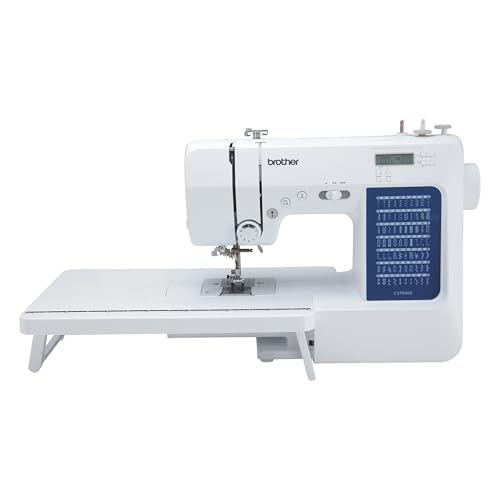 Brother CS7000X Computerized Sewing & Quilting Machine The first machine most beginners should buy | 70 built-in stitches | 9.2/10 | |
| 2 |  Brother CS5055 Computerized Sewing Machine The most stitches per dollar of any machine here | 60 built-in stitches, 7 buttonhole styles | 8.5/10 |
The first machine most beginners should buy
Brother CS7000X Computerized Sewing & Quilting Machine
The only machine on this page that arrives with the two feet a beginner ends up buying anyway — a walking foot and a quarter-inch foot — plus an automatic needle threader and a drop-in bobbin, so the two jobs that make people quit are the two jobs it makes easy.
The CS7000X is the machine we point a first-time buyer at, and the reason has nothing to do with its stitch count. It is the presser feet. Brother lists ten of them in the box — zigzag, buttonhole, zipper, button sewing, overcasting, blind stitch, monogramming, quarter-inch, quilting and walking — plus a quilt guide. Two of those, the walking foot and the quarter-inch foot, are the exact accessories a beginner ends up ordering three months in, and they are not cheap bought separately.
The second reason is the threading. Brother's published specification lists an automatic needle threading system and a quick-set drop-in top bobbin. Threading the needle and setting the bobbin are the two jobs that make people put a machine back in its box, and this one turns both into a lever pull and a drop. On a front-loading machine you are removing a case, seating a bobbin in a particular orientation, and hoping.
It is a computerized machine, which means stitch selection is a mode key and a shift key against an LCD rather than a dial. That is a genuine trade-off, not a straight upgrade: a dial is legible at a glance and has nothing to fail, while an LCD tells you the stitch width and length the machine has actually selected. For someone learning, seeing the numbers is worth more than the simplicity of a dial.
The extras matter more than they sound. The detachable wide table turns a small free-arm machine into something you can push a quilt across, and the hard protective cover is the difference between a machine that stays out on a table and one that lives in a cupboard collecting dust. Brother also publishes a 25-year limited warranty and free phone and online technical support for the life of the product.
We have not sewn on this machine. Everything above is from Brother's own specification page, and the price on the button is live from Amazon rather than anything we typed. What we can tell you is what the box contains and what that saves you buying — which, for a first machine, is most of the decision.
What works
- Automatic needle threader and a drop-in bobbin — the two setup jobs that defeat most beginners
- Ten presser feet including the walking foot and a quilting foot, which the cheaper machines make you buy separately
- Detachable wide table and a hard cover are in the box, not extras
- Adjustable sewing speed control, so a first seam can be run slowly
- Brother publishes a 25-year limited warranty on it
What does not
- Seventy stitches is far more than a beginner will use; you are paying for decorative stitches you may never touch
- Computerized machines have more to go wrong electronically than a dial-and-lever mechanical
- At 10.5 lb it is light enough to walk across a table at speed unless it is on a firm surface
The kit it pairs with: It already includes the walking foot and quilting foot, so its starter kit is short: needles, bobbins, thread, shears and pins.
The most stitches per dollar of any machine here
Brother CS5055 Computerized Sewing Machine
Sixty stitches, seven one-step buttonhole styles and an automatic needle threader on a 10.5 lb computerized machine — the cheapest route to the features that actually make garment sewing pleasant.
The CS5055 is the machine we would point at if someone said 'I want a computerized machine and I do not want to spend CS7000X money.' Brother lists 60 built-in stitches including seven styles of one-step auto-size buttonhole, an automatic needle threading system, a quick-set drop-in bobbin, an LCD with computerized stitch selection, a free arm and an LED-lit work area, on a machine that weighs a published 10.5 lb.
Seven buttonhole styles is the specification worth stopping on. A buttonhole style is not decoration — a keyhole buttonhole is for a thick shanked coat button, a rounded one for fine blouse fabric, a stretch construction for knits, a plain bar-tacked rectangle for shirts. Most machines at this price have one style or, on the mechanical models, a four-step buttonhole you steer by eye. Seven is what the XR9550 has eight of at a considerably higher list price.
Sixty stitches is more than anyone needs and that is fine — you will use four. The reason the number matters here is what comes with it: computerized selection means the stitch width and length are numbers on a screen rather than dial positions you have to remember, which is the practical difference between a mechanical and a computerized machine. We cover that trade in full here.
What Brother leaves out is the accessory package. Seven feet — zigzag, buttonhole, zipper, button sewing, overcasting, blind stitch and monogramming — and no walking foot, no quarter-inch foot, no wide table and no hard cover. Those four items are most of what separates this machine from the CS7000X, and if you intend to quilt they are exactly the four you would want. What a walking foot does explains why it is the one worth buying first.
Two other absences are worth naming because they are easy to assume: Brother lists adjustable presser foot pressure as 'No', so this is not a denim machine, and there is no automatic thread cutter, needle position key or start/stop button. The top speed is 750 stitches per minute, the slowest figure we have on file — gentle for learning, slow if you are sewing curtains.
We have not sewn on this machine. Every specification above was read off Brother's own product page on 13 September 2026, where the machine was listed in stock at $169.99.
What works
- Seven one-step auto-size buttonhole styles — more than the CS7000X's seven-at-a-higher-price and vastly more than any mechanical machine here
- 60 built-in stitches with computerized selection on an LCD, so the stitch you set is a number you can read and repeat
- Automatic needle threading and a quick-set drop-in bobbin: the two specifications that most reduce early frustration
- 10.5 lb, so it can live on a shelf and come down for an hour
- A 7 mm maximum stitch width, wider than the 6 mm the SINGER Heavy Duty machines publish
- 25-year limited warranty, the same term Brother publishes on the CS7000X
What does not
- No walking foot and no quarter-inch foot in the seven — if you intend to quilt, those are two accessories you will buy
- No wide table and no hard cover, both of which the CS7000X includes
- Adjustable presser foot pressure: No, so thick multi-layer seams are not this machine's job
- 750 stitches per minute is the slowest top speed we have on file — fine for learning, limiting for long production seams
- No automatic thread cutter, no needle up/down key and no start/stop button, all of which appear higher up Brother's range
The kit it pairs with: A walking foot and a quarter-inch foot if quilting is on the list, plus universal needles in 80/12 and 90/14 and extra bobbins.
Start with what does not differ
It is worth clearing these off first, because they are the specifications people assume separate a cheaper machine from a dearer one and here they simply do not.
- Needle threading. Both automatic. This is the specification we would protect first on any machine and neither gives it up.
- Bobbin. Both quick-set drop-in. Lift a clear lid, drop the bobbin in, pull the thread through a slot — no removable case, no orientation to get wrong. Why that matters.
- Buttonhole. Brother publishes seven styles of one-step auto-size buttonhole on both. That is the single most surprising line in this comparison — buttonhole range is usually where a cheaper machine is cut, and it is not cut here.
- Weight. Both a published 10.5 lb.
- Warranty. Both 25-year limited.
Now the four things that do
Compiled from Brother USA's own product pages for both machines, both read on 13 September 2026.
Ten stitches, three feet, a table, a cover and a speed slider, for a hundred and ten dollars at Brother's own list prices. Whether that is good value depends entirely on one question.
The question is whether you quilt
Three of the CS7000X's extras exist for quilting specifically. The walking foot adds a second set of feed dogs above the fabric so the top layer of a quilt sandwich advances in time with the bottom — without one, the layers shift and the finished quilt ripples. The quarter-inch foot puts a physical edge exactly a quarter inch from the needle, which is the seam allowance every quilt pattern is built on. The wide table supports the weight of a quilt that would otherwise drag off a free arm and distort every seam.
Bought separately, the walking foot is the most expensive presser foot most people ever buy. What it does and why goes through the mechanism. Add the quarter-inch foot and the table and you are a meaningful way toward the price difference — which is exactly why the CS7000X leads our quilting roundup.
If you are sewing clothes, repairs and home projects, none of those three does anything for you. A garment sewer uses the zigzag, the buttonhole, the zipper foot and the blind stitch foot, and the CS5055 has every one of them.
The speed control, and who it is for
Brother publishes an adjustable sewing speed control on the CS7000X — a slider that caps top speed regardless of how hard the pedal is pressed — and does not list one on the CS5055.
That matters in one specific case: a nervous beginner, or a child. It is the deciding specification on our roundup for kids for exactly that reason. The mitigating fact for the CS5055 is that its own published top speed is 750 stitches per minute, the slowest figure we have on file — so the pedal has a wider usable band than on a 1,100 spm heavy-duty machine even without a limiter.
Where the CS5055 actually wins
Two places, and both are small but real. Brother publishes a 7 mm maximum stitch width on the CS5055 and does not publish a width figure for the CS7000X, so on the numbers available the cheaper machine has the wider zigzag — useful for appliqué and for overcasting a raw edge properly.
And it wins on price per feature for the buyer who will never quilt. Sixty stitches, seven buttonhole styles, an automatic threader and a drop-in bobbin at Brother's lowest computerized list price is a lot of machine, and the money saved buys a very large amount of fabric.
The honest shared weakness
Brother lists 'Adjustable Presser Foot Pressure: No' on both. Neither is a denim or canvas machine. On a thick multi-layer seam the feed dogs lose their grip on fabric that bridges rather than sitting flat, and without a pressure dial there is nothing to press it back down. Both will hem a single or double layer of denim with a 100/16 needle; neither will climb a flat-felled jeans side seam reliably. That job belongs to the denim roundup.
The verdict
Buy the CS7000X if quilting is on the list, now or plausibly later. The walking foot, quarter-inch foot and wide table are the three things you would buy afterwards anyway, and buying them in a carton is cheaper than buying them one at a time. Buy it too if the machine is for a child or a nervous first-timer, for the speed slider.
Buy the [CS5055](/reviews/brother-cs5055) if you sew clothes, repairs and home projects. You give up ten stitches you will not use and three accessories you will not miss, and you keep the automatic threader, the drop-in bobbin and all seven buttonhole styles — which is the entire list of things that make garment sewing pleasant.
Do not buy either for thick fabric. Neither has adjustable presser foot pressure, and no amount of stitch count substitutes for it.
Method
How we picked
- Read both Brother product pages on the same day — 13 September 2026 — so the specification and price comparison is same-day rather than assembled from different weeks.
- Confirmed both machines are currently listed in stock on Brother's own store before recommending either.
- Compared the published carton contents item by item, because on these two machines that is where almost all of the difference is.
- Wrote 'Not published' rather than guessing wherever Brother does not publish a figure — which on this pair includes the CS7000X's top speed and maximum stitch width.
- Pulled every price on the buttons live from Amazon. The list prices quoted in prose are Brother's own, attributed and dated.
We have not sewn on these machines. There is no test bench here, we do not own them, and we do not accept free product. Everything above is compiled from published manufacturer specifications and live retailer data — and we tell you which is which on every claim. Our full method.
Answers
Questions people ask
Is the Brother CS7000X worth the extra over the CS5055?
Do the Brother CS5055 and CS7000X have the same buttonhole?
Which is better for beginners, the CS5055 or the CS7000X?
Can the Brother CS5055 or CS7000X sew denim?
How many presser feet come with each?
Where this came from
Sources
About the author
Scooter M.
An enthusiast who is genuinely into this. I read the manuals, compile the published specs, and do the arithmetic. No lab coat, no test bench, and no machines I am pretending to have used — which is exactly why every claim here carries a source.
Published by Slate Mill Group. Published September 13, 2026; last updated September 13, 2026. Editorial policy.
Keep reading
Read next
Most stitches per dollar
Brother CS5055 review: the cheapest computerized machine that sews a proper buttonhole
60 stitches, seven one-step buttonhole styles and an automatic threader — the cheapest computerized machine we cover.
Our top first machine
Brother CS7000X review: you are buying the presser feet, not the stitches
Ten presser feet, an automatic threader and a drop-in bobbin — the machine we point most first-time buyers at.
Best for quilting
The best sewing machines for quilting beginners
The three specifications that decide quilting, and the two machines plus three accessories that satisfy them.
Walking foot
What a walking foot actually does
The one-sentence explanation, the four jobs it fixes, and which machines include one in the box.