Stitch & Selvage earns a commission when you buy through the links on this page, at no extra cost to you. It does not change what we recommend, and we publish a skip-this verdict on products we could otherwise earn from. Full disclosure.
Both include a walking foot, a quarter-inch foot, a wide table, an automatic threader and a quick-set drop-in bobbin. The CS7205 adds 135 more stitches, an alphabet, an eighth buttonhole style, an eleventh presser foot, a start/stop button and a needle position key for ten dollars more. The CS7000X adds a hard cover and a simpler machine to meet on day one.
The ranking
Quick picks
Ranked against the published criteria below. Tap a row to jump to the full write-up; the price button goes straight to Amazon.
| # | Product | Best for | Score | Price |
|---|---|---|---|---|
| 1 | 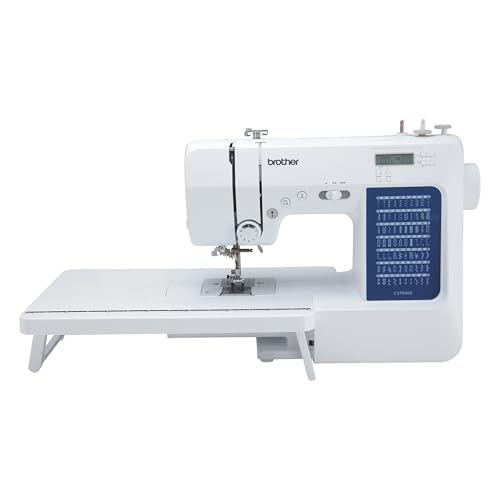 Brother CS7000X Computerized Sewing & Quilting Machine The first machine most beginners should buy | 70 built-in stitches | 9.2/10 | |
| 2 |  Brother CS7205 Computerized Sewing Machine The most machine in one carton | 205 built-in stitches, 8 buttonhole styles | 9.0/10 |
The first machine most beginners should buy
Brother CS7000X Computerized Sewing & Quilting Machine
The only machine on this page that arrives with the two feet a beginner ends up buying anyway — a walking foot and a quarter-inch foot — plus an automatic needle threader and a drop-in bobbin, so the two jobs that make people quit are the two jobs it makes easy.
The CS7000X is the machine we point a first-time buyer at, and the reason has nothing to do with its stitch count. It is the presser feet. Brother lists ten of them in the box — zigzag, buttonhole, zipper, button sewing, overcasting, blind stitch, monogramming, quarter-inch, quilting and walking — plus a quilt guide. Two of those, the walking foot and the quarter-inch foot, are the exact accessories a beginner ends up ordering three months in, and they are not cheap bought separately.
The second reason is the threading. Brother's published specification lists an automatic needle threading system and a quick-set drop-in top bobbin. Threading the needle and setting the bobbin are the two jobs that make people put a machine back in its box, and this one turns both into a lever pull and a drop. On a front-loading machine you are removing a case, seating a bobbin in a particular orientation, and hoping.
It is a computerized machine, which means stitch selection is a mode key and a shift key against an LCD rather than a dial. That is a genuine trade-off, not a straight upgrade: a dial is legible at a glance and has nothing to fail, while an LCD tells you the stitch width and length the machine has actually selected. For someone learning, seeing the numbers is worth more than the simplicity of a dial.
The extras matter more than they sound. The detachable wide table turns a small free-arm machine into something you can push a quilt across, and the hard protective cover is the difference between a machine that stays out on a table and one that lives in a cupboard collecting dust. Brother also publishes a 25-year limited warranty and free phone and online technical support for the life of the product.
We have not sewn on this machine. Everything above is from Brother's own specification page, and the price on the button is live from Amazon rather than anything we typed. What we can tell you is what the box contains and what that saves you buying — which, for a first machine, is most of the decision.
What works
- Automatic needle threader and a drop-in bobbin — the two setup jobs that defeat most beginners
- Ten presser feet including the walking foot and a quilting foot, which the cheaper machines make you buy separately
- Detachable wide table and a hard cover are in the box, not extras
- Adjustable sewing speed control, so a first seam can be run slowly
- Brother publishes a 25-year limited warranty on it
What does not
- Seventy stitches is far more than a beginner will use; you are paying for decorative stitches you may never touch
- Computerized machines have more to go wrong electronically than a dial-and-lever mechanical
- At 10.5 lb it is light enough to walk across a table at speed unless it is on a firm surface
The kit it pairs with: It already includes the walking foot and quilting foot, so its starter kit is short: needles, bobbins, thread, shears and pins.
The most machine in one carton
Brother CS7205 Computerized Sewing Machine
Eleven presser feet including a walking foot, a quarter-inch foot and a stitch guide foot, plus a wide table, a 2-inch LCD, eight buttonhole styles, a start/stop button and 7-point feed dogs. On published specification nothing else we cover comes close for the money.
The CS7205 is the machine that makes the rest of Brother's consumer range look thin, and the reason is the carton. Brother lists eleven presser feet: walking, quarter-inch, spring-action quilting, stitch guide, buttonhole, zipper, overcasting, blind stitch, monogramming, zigzag and button sewing. Our previous benchmark for a generous box, the CS7000X, lists ten.
Two of those eleven are the ones that normally cost real money afterwards. The walking foot adds a second set of feed dogs above the fabric so a quilt sandwich advances evenly. The quarter-inch foot gives you a physical edge exactly a quarter inch from the needle, which is the seam allowance every quilt pattern assumes. A third — the stitch guide foot — appears on nothing else we cover; it carries seam-allowance markings on the foot itself, at the needle, rather than on the plate several inches behind where you are actually looking.
The controls are a step up too. Brother publishes a start/stop button, so the machine will sew without the foot pedal at all; a needle position key with needle stop up/down, which is how you pivot cleanly at a corner; a 2-inch back-lit LCD with built-in memory; and an independent bobbin winding motor, which means winding a bobbin does not require unthreading the top of the machine. It also publishes 7-point feed dogs, the same count as the heavy-duty ST150HDH and more than the 6-point arrangement on the XR3774.
About the stitch count, because the numbers do not agree. Brother's own product page says 205 built-in stitches, including 55 alphanumeric and 8 one-step buttonholes. Every Amazon listing for this machine says 150. Those are not contradictory once you do the arithmetic: 205 minus the 55 alphanumeric characters is exactly 150. The most likely explanation is that one count includes the monogramming alphabet and the other does not. We quote Brother's figure because our rule is the manufacturer's published specification, and we are flagging the discrepancy rather than quietly picking the bigger number.
What it gives up against the CS7000X is a hard case — Brother's carton contents here list the wide table and no cover at all. That is a real omission on a machine otherwise this well equipped, and it is the reason to think twice if yours has to be stored on a shelf.
Two further absences worth naming: Brother lists adjustable presser foot pressure as 'No', so thick multi-layer seams are not this machine's job, and there is no automatic thread cutter, with thread tension set manually. And one genuine gap in the published data — Brother does not state whether this machine has a free arm. Nearly everything in this class does, but it is not published here, so we are not going to tell you it does.
One last oddity, reported as found: the warranty on Brother's own CS7205 page renders as '1/5/25 Year Limited Serger Warranty'. This is not a serger. We assume that is a labeling error in Brother's data rather than a different warranty, but we are quoting the string Brother actually publishes rather than substituting the one we expect.
We have not sewn on this machine. Every specification above was read off Brother's own product page on 14 September 2026, where it was listed in stock at $289.99.
What works
- Eleven presser feet — more than any other machine we cover, and they include the walking foot AND the quarter-inch foot, which are the two people usually buy afterwards
- A stitch guide foot, which no other machine here includes: it puts seam-allowance markings right at the needle instead of on the needle plate behind it
- Eight one-step buttonhole styles, matching the XR9550 and beating everything else on the site
- A start/stop button, so you can sew without the foot pedal — genuinely useful for free-motion work and for anyone who finds pedal control hard
- A needle position key with needle stop up/down, which is what lets you pivot accurately at a corner without turning the handwheel
- 7-point feed dogs and a wide table, plus an independent bobbin winding motor so you can wind a bobbin without unthreading the machine
- 10.14 lb, the lightest figure Brother publishes across the machines we cover
What does not
- No hard case. Brother's carton contents list a wide table and no cover of any kind — the CS7000X includes a hard protective cover
- Adjustable presser foot pressure: No. Not a denim, canvas or upholstery machine
- No automatic thread cutter, and thread tension is manual rather than automatic
- Brother does not publish a free arm for this machine anywhere on its product page. We are not going to assume one — check before you buy if you hem trouser legs
- 205 stitches is more than anyone needs. You will use four, and the count is the least predictive number on any specification sheet
- Amazon's listings for this machine say 150 built-in stitches where Brother says 205 — see the note below before you assume either is wrong
The kit it pairs with: Almost nothing on the accessory side — the walking foot and quarter-inch foot are already in the box. Add universal needles in 80/12 and 90/14, extra bobbins, and a dust cover, since Brother does not include one.
What does not differ, which is most of it
This comparison is unusual because the expensive part of a sewing machine — the carton — is almost identical on both.
- A walking foot. Both. It adds a second set of feed dogs above the fabric so a quilt sandwich advances evenly, and bought separately it is the priciest presser foot most people ever own. What it does.
- A quarter-inch piecing foot. Both. The seam allowance every quilt pattern assumes, as a physical edge rather than a line you eyeball.
- A detachable wide table. Both. Somewhere for a quilt to rest so its weight does not drag on the feed.
- An automatic needle threader and a quick-set drop-in bobbin. Both. The two specifications whose absence beginners actually complain about.
- Adjustable presser foot pressure: 'No'. Both. Neither is a denim or upholstery machine.
If quilting is why you are buying, you can stop reading here: either machine gives you the full quilting package. The rest of this page is about ten dollars.
The table
Compiled from Brother USA's own product pages for both machines, both read on 19 September 2026.
The case for the CS7205
On raw specification it is not close. For ten dollars you get 135 more stitches, 55 alphanumeric characters and a monogramming font, an eighth buttonhole style, and an eleventh presser foot — the stitch guide foot, which carries seam-allowance markings on the foot itself at the needle rather than engraved on the plate several inches behind where you are looking.
The controls are the less obvious win. A start/stop button runs the machine without the foot pedal, which matters for free-motion quilting where you want both hands on the fabric. A needle position key parks the needle down so you can pivot at a corner without touching the handwheel. An independent bobbin winding motor lets you wind a bobbin without unthreading the top of the machine. Brother publishes none of those three for the CS7000X.
It is also the lighter machine at a published 10.14 lb against 10.5 lb, and the only one of the two with a published feed dog count (7-point).
The case for the CS7000X, which is narrower and real
The hard cover. Brother includes a hard protective cover with the CS7000X and lists no cover of any kind with the CS7205 — not even a soft one. If your machine lives on a shelf between projects, that is not a trivial accessory: dust and lint settling in the bobbin race and tension discs is a genuine cause of the gradual stitch problems people cannot later explain. Machine maintenance covers it, and the lightweight roundup ranks which machines ship with a case at all.
A published adjustable speed control. Brother lists one explicitly on the CS7000X. For the CS7205 the marketing description mentions variable speed but no specification attribute confirms it. On a machine for a nervous beginner or a child that difference is worth having in writing — it is the deciding specification on our roundup for kids.
Less to meet on day one. Seventy stitches on a simple LCD is a smaller interface than 205 stitches plus an alphabet. That is not a specification and we will not pretend it is measurable, but it is a real consideration for somebody who has never threaded a machine.
One oddity in Brother's own data
The warranty on Brother's CS7205 page renders as '1/5/25 Year Limited Serger Warranty'. The CS7205 is not a serger. We take it for a labeling error rather than a genuinely different warranty, but we quote the string Brother publishes rather than substituting the 25-year limited warranty the CS7000X carries and that we would expect here.
The verdict
Buy the CS7205 if the machine has a permanent home. More stitches, more feet, better controls, lighter, ten dollars. On a table where it stays set up, there is no argument for the CS7000X on specification.
Buy the CS7000X if the machine gets put away, or if it is a first machine for someone nervous. The hard cover and the explicitly published speed limiter are worth more than 135 stitches you will not use — and you will use four. It remains the machine we point most first-time buyers at.
Ignore both if thick fabric is the job. Neither has adjustable presser foot pressure; the denim roundup is the page you want.
Method
How we picked
- Read both Brother product pages on the same day — 19 September 2026 — so the specification and price comparison is same-day rather than assembled from different weeks.
- Confirmed both machines are currently in stock on Brother's own store and on Amazon before recommending either.
- Compared the published carton contents item by item, because on these two machines the cartons are nearly identical and the differences are easy to miss.
- Wrote 'Not published' rather than guessing wherever Brother publishes nothing — which on the CS7000X includes the start/stop button, needle position key, bobbin motor and feed dog count.
- Quoted Brother's own warranty string for the CS7205 rather than substituting the one we would expect.
- Pulled every price on the buttons live from Amazon. The list prices in prose are Brother's own, attributed and dated.
We have not sewn on these machines. There is no test bench here, we do not own them, and we do not accept free product. Everything above is compiled from published manufacturer specifications and live retailer data — and we tell you which is which on every claim. Our full method.
Answers
Questions people ask
Is the Brother CS7205 better than the CS7000X?
Do both the CS7000X and CS7205 come with a walking foot?
Which is better for a beginner, the CS7000X or CS7205?
Does the Brother CS7205 come with a case?
Which is lighter, the CS7000X or the CS7205?
Where this came from
Sources
About the author
Scooter M.
An enthusiast who is genuinely into this. I read the manuals, compile the published specs, and do the arithmetic. No lab coat, no test bench, and no machines I am pretending to have used — which is exactly why every claim here carries a source.
Published by Slate Mill Group. Published September 21, 2026; last updated September 21, 2026. Editorial policy.
Keep reading
Read next
Our top first machine
Brother CS7000X review: you are buying the presser feet, not the stitches
Ten presser feet, an automatic threader and a drop-in bobbin — the machine we point most first-time buyers at.
Best equipped
Brother CS7205 review: the most loaded carton Brother sells at this price
Eleven presser feet, eight buttonhole styles, a wide table and a start/stop button — the most equipment in one carton at this price.
Best Brother
The best Brother sewing machines
Fourteen Brother machines on one page, ranked by the job you are buying for — with same-day list prices and the one to skip.
Best for quilting
The best sewing machines for quilting beginners
The three specifications that decide quilting, and the two machines plus three accessories that satisfy them.