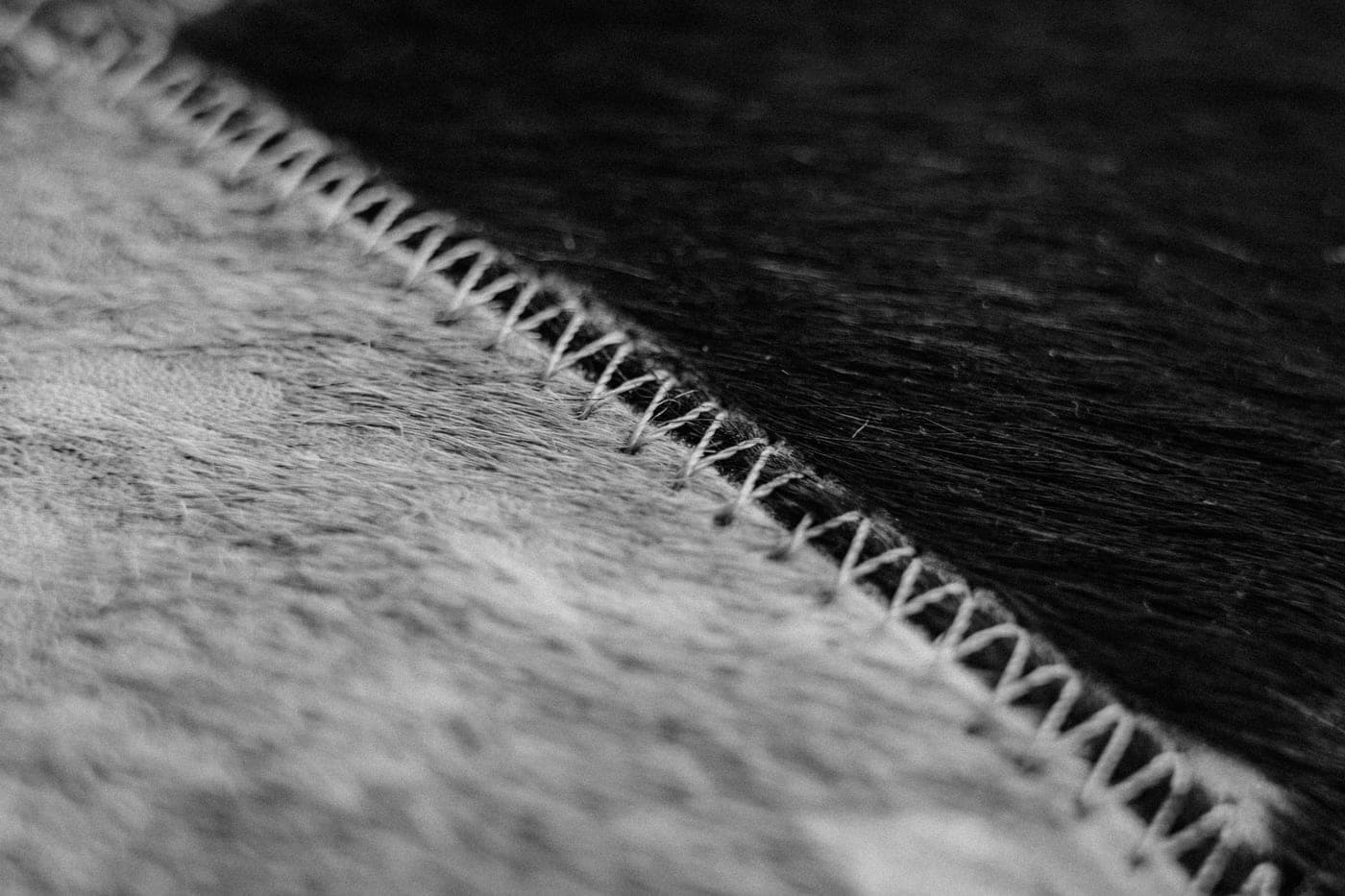
A skipped stitch means the bobbin hook passed the needle and missed the loop of top thread. Change the needle first — a new one, correct type for the fabric, flat side of the shank to the back, pushed all the way up into the clamp. That resolves most cases, costs almost nothing and takes a minute.
What is physically happening
Worth thirty seconds, because it makes every fix below obvious rather than a list to memorize.
The needle carries the top thread down through the fabric and starts to rise. As it rises, friction against the fabric holds the thread back for an instant, so a small loop forms on one side of the needle just above the eye. The bobbin hook sweeps past at exactly that moment, catches the loop, and carries it around the bobbin.
The timing window is fractions of a millimeter and fractions of a second. Anything that stops the loop forming, or puts it in the wrong place, means the hook sweeps through empty air — and you get a stitch that simply is not there.
That is why the needle dominates this list. Almost everything that disturbs the loop is a needle problem.
The six causes, in order of likelihood
1. The needle is not pushed fully up into the clamp
The most common cause and the most overlooked. If the needle sits even half a millimeter low, everything about the loop's position is off by that much and the hook passes above it.
Loosen the needle clamp screw, push the needle up until it physically stops, hold it there and tighten. It is worth redoing this even if you are sure you did it right — it is a five-second check that resolves the problem surprisingly often.
2. The needle is blunt or bent
A needle blunts after roughly eight hours of sewing and looks identical to a new one. A blunt point pushes the fabric down instead of piercing it cleanly, which changes where and when the loop forms. A bent needle — and any needle that has struck a pin is bent, whether or not you can see it — sits fractionally off-center so the hook misses.
Change it at the start of any project you care about and after about eight hours of sewing. This is the cheapest maintenance in sewing and the most skipped.
3. The needle is in backwards
On almost every domestic machine the flat side of the shank faces the back. The needle has a long groove down the front to shelter the thread and a hollow scarf above the eye on the back where the hook passes. Fit it the wrong way round and the hook is sweeping past the solid side. Check your manual — a few machines differ.
4. The needle is the wrong type for the fabric
This is the big one on knits, and the one people are most surprised by.
A sharp point on knit fabric cuts the loops of the knit instead of sliding between them, which both damages the cloth and disturbs the loop formation. SCHMETZ's jersey / ball point needle is published as 'designed for sewing on knits and some stretch fabrics'.
For very elastic fabric — swimwear, activewear, anything with a lot of elastane — SCHMETZ publishes a separate stretch needle 'designed with a deep scarf to prevent skipped stitches'. That is the mechanism stated explicitly: on a very stretchy fabric the cloth moves down with the needle as it enters, so the loop forms late and small, and a deeper scarf gives the hook more room to find it.
In thick woven fabric the failure is different but still the needle: a standard blade deflects sideways in multiple layers, so the loop is not where the hook expects. SCHMETZ's denim needle has a reinforced blade published for exactly that — 'minimum needle deflection, reduced risk of needle breakage and skipped stitches'.
The ranking
Quick picks
Ranked against the published criteria below. Tap a row to jump to the full write-up; the price button goes straight to Amazon.
The needle you should already own two packs of
Universal machine needles, 80/12 and 90/14
A slight ball point that sews both knit and woven fabric, which is why it is the only needle a first project actually requires — and the one most people never replace often enough.
SCHMETZ describes the universal needle in seven words: 'General sewing of knit and woven fabrics. Slight ball point.' That slight ball point is the whole design. A perfectly sharp point pierces the yarns of a woven cloth cleanly and cuts through the loops of a knit, causing runs. A full ball point pushes knit loops aside but struggles to pierce a dense woven. The universal splits the difference, badly enough that a specialist needle beats it on any one fabric, and well enough that it is the only needle a first project needs.
Buy sizes 80/12 and 90/14, and understand what the two numbers mean: they are the same measurement in two systems, metric (NM) and imperial (Singer). An 80/12 is 0.8 mm across the blade. Lighter fabric wants a smaller number; heavier fabric wants a bigger one. Quilting cotton and shirting sew happily on an 80/12. Denim-weight woven, canvas and multiple layers want a 90/14.
The mistake almost every beginner makes is not buying the wrong needle, it is keeping the right one too long. A needle blunts from the friction of passing through fabric thousands of times, and a blunt needle is a leading cause of skipped stitches, snagged fabric and thread that keeps breaking — the exact symptoms people diagnose as a broken machine. Change it when you start a significant project, and change it after roughly eight hours of sewing.
SCHMETZ publishes universal needles from 60/8 up to 120/19, plus assorted packs, twin needles and triple needles. An assorted pack is the right first purchase because it lets you find out which size your fabric actually likes without buying five packs.
What works
- Sews knit and woven fabric acceptably, which no other needle type does
- The widest size range SCHMETZ publishes for any home needle — 60/8 through 120/19
- An assorted pack covers a beginner's first year of fabrics for the price of a coffee
- Sold as a twin and a triple needle for hems and decorative topstitching
What does not
- A compromise by design — for a stretchy knit a jersey needle skips fewer stitches, and for heavy denim a denim needle deflects less
- Blunts long before it looks blunt; a needle that has sewn eight hours is due for replacement
- Twin needles are not compatible with every stitch on every machine — check your manual first
T-shirt fabric and anything that stretches
Jersey / ball point needles
The needle that stops a knit from laddering — the difference between a T-shirt seam that holds and one that runs the first time it is stretched.
A knit fabric is made of loops, not a grid. Push a sharp needle through a loop and you sever it, and a severed loop unravels — that is what a run in a T-shirt is, and it is why a first attempt at hemming a jersey top so often produces a line of small holes along the stitching.
SCHMETZ describes the jersey / ball point needle as 'designed for sewing on knits and some stretch fabrics' and publishes it in 70/10, 80/12, 90/14 and 100/16, plus an assorted pack. The rounded tip slips between the loops rather than through them.
There is a second needle worth knowing about, because people buy the wrong one of the pair. SCHMETZ also publishes a stretch needle, 'designed for synthetic suede or elastic knitwear' with 'a deep scarf to prevent skipped stitches'. The scarf is the groove above the eye where the bobbin hook passes. On a very elastic fabric the material moves as the needle enters, the hook misses the loop of top thread and you get a skipped stitch; a deeper scarf gives the hook more room. So: jersey needle for ordinary T-shirt knits, stretch needle for swimwear, activewear and anything with elastane.
If your machine has been skipping stitches on knit fabric, change the needle before you change anything else. It is the cheapest fix on the list and it is right more often than any tension adjustment.
What works
- Pushes knit loops aside instead of cutting them, which is what prevents runs and holes
- Fixes most 'my machine skips stitches on T-shirt fabric' problems without touching a setting
- Cheap enough that there is no reason not to own a pack before you sew your first knit
What does not
- Wrong needle for woven fabric — the rounded point struggles to pierce a dense weave
- SCHMETZ lists a separate stretch needle with a deeper scarf for elastic knitwear and synthetic suede; for very stretchy fabric that is the better tool
- Not a substitute for a walking foot or a stretch stitch — it solves the needle half of the problem only
Hemming jeans and anything thick
Denim / jeans needles, 90/14 and 100/16
A reinforced blade and a medium ball point built to go through layers without deflecting — the needle that turns 'my machine cannot hem jeans' into a job it can do.
Hemming jeans is the single most common reason someone buys a first sewing machine, and it is the job most likely to end with a broken needle. The reason is deflection. SCHMETZ's own description of the denim needle names it directly: the needle is built 'for penetrating extra thick woven fabrics, denims, or quilts with minimum needle deflection, reduced risk of needle breakage and skipped stitches.'
Here is what deflection means in practice. A standard needle blade is thin enough to flex. Drive it into six layers of denim at the seam and it bends a fraction of a millimeter sideways. That is enough to make it miss the bobbin hook — a skipped stitch — or to hit the edge of the needle plate hole, which snaps it. A denim needle has a thicker, stiffer blade so it goes where it was pointed.
The point geometry is the other half. SCHMETZ specifies a medium ball point, not a sharp one, which sounds backwards for a tough fabric and is not: denim is a tight weave, and a medium ball point slides between the warp and weft yarns rather than cutting them, which is less damaging to the cloth and less likely to blunt the needle.
Buy 100/16 for jeans hems and 90/14 for heavy cotton, canvas and multi-layer quilting seams. SCHMETZ publishes the range from 70/10 to 110/18 plus a twin denim needle — that twin is what produces the two parallel gold topstitch lines a factory jeans hem has, in one pass.
What works
- The reinforced blade is the point: a universal needle bends in thick layers, and a bent needle hits the plate and breaks
- SCHMETZ lists it for quilts as well as denim — multiple layers are multiple layers
- Sold as a twin needle, which is how you sew the double topstitch line a jeans hem has
- An advanced point design SCHMETZ describes as exclusive to it
What does not
- Overkill and slightly damaging on light fabric — a 100/16 leaves visible holes in shirting
- A needle alone will not hem jeans if your machine cannot feed the bulk; presser foot pressure and a hump-jumper matter too
- The heaviest sizes are more than most beginner machines are rated to drive comfortably
5. You are pulling the fabric
Pulling or steering fabric through faster than the feed dogs are moving it deflects the needle sideways at exactly the moment the loop should form. It also blunts needles and breaks them.
Let the feed dogs do the work. Guide the fabric from the sides, keep your hands relaxed, and if the machine is not feeding fast enough for you, change the stitch length rather than helping it along.
6. Threading, tension or a lint build-up
Less common for skipping specifically, but worth ruling out once the needle is eliminated. Rethread the top with the presser foot up — a top thread with no tension does not form a clean loop. Check the bobbin is seated correctly. And brush the lint out of the bobbin race, because a compacted pad under the bobbin changes how the whole assembly sits.
The two-minute fix sequence
- Fit a brand new needle, correct type for your fabric, flat side of the shank to the back, pushed all the way up until it stops.
- Rethread the top with the presser foot UP, needle at its highest point.
- Reload the bobbin, checking the thread unwinds in the direction printed on the machine.
- Test on two layers of scrap in the same fabric as your project.
- If it still skips, change needle type — ball point for knits, stretch for very elastic fabric, denim for thick woven.
- If it still skips with a new correct needle and correct threading, stop. That is a timing issue and it is a service job, not a home repair.
Fabric-specific quick reference
Needle types and descriptions as published in the SCHMETZ Sewing Machine Needle Primer, checked 1 September 2026.
When it is not the needle
If a correctly fitted, brand-new, correct-type needle on a correctly threaded machine still skips stitches on plain scrap fabric, the likely cause is timing — the relationship between the needle's position and the hook's sweep has drifted. That is not adjustable at home on a domestic machine and attempting it usually makes things worse.
Other signs pointing the same way: the needle strikes the needle plate, the stitch is consistently off-center, or there is a new grinding or knocking noise. Those are service symptoms. When to get a machine serviced covers the full list.
Answers
Questions people ask
Why is my sewing machine skipping stitches?
Why does my machine skip stitches on knit fabric?
Can the wrong thread cause skipped stitches?
Which way round does a sewing machine needle go?
My needle is new and it still skips. What now?
Where this came from
Sources
About the author
Scooter M.
An enthusiast who is genuinely into this. I read the manuals, compile the published specs, and do the arithmetic. No lab coat, no test bench, and no machines I am pretending to have used — which is exactly why every claim here carries a source.
Published by Slate Mill Group. Published September 6, 2026; last updated September 6, 2026. Editorial policy.
Keep reading
Read next
Troubleshooting
Sewing machine problems and how to fix them
Five faults, their real causes, and the sequence to check in — starting with the two that fix most of them.
Needles
Sewing machine needles explained
What the two numbers mean, which needle each fabric wants, and the eight-hour rule for changing them.
Sewing knits
Sewing knit fabrics without a serger
Ball point needle, a stitch with give, and a walking foot — the three fixes for knits on an ordinary machine.
Tension
Sewing machine tension, explained
How to read a bad stitch, which thread is at fault, and the rule that stops you making it worse.