Stitch & Selvage earns a commission when you buy through the links on this page, at no extra cost to you. It does not change what we recommend, and we publish a skip-this verdict on products we could otherwise earn from. Full disclosure.
Moving up a tier buys four published things: automatic needle threading, a one-step buttonhole, more presser feet, and a case or cover. The first of those is worth the difference on its own, because you use it every time you change thread and it is the feature most likely to decide whether the machine keeps getting used.
The ranking
Quick picks
Ranked against the published criteria below. Tap a row to jump to the full write-up; the price button goes straight to Amazon.
| # | Product | Best for | Score | Price |
|---|---|---|---|---|
| 1 | No photo Brother LX3817 Sewing Machine Mending and hemming on the smallest budget Our skip-this pick | 17 built-in stitches | 6.3/10 | Check price on Amazon #ad affiliate link · no live price for this item |
| 2 |  Brother XM2701 Sewing Machine The cheapest machine that still threads itself | 27 built-in stitches | 8.0/10 | $149.00 on Amazon #ad affiliate link · price as of October 17, 2026 |
| 3 | 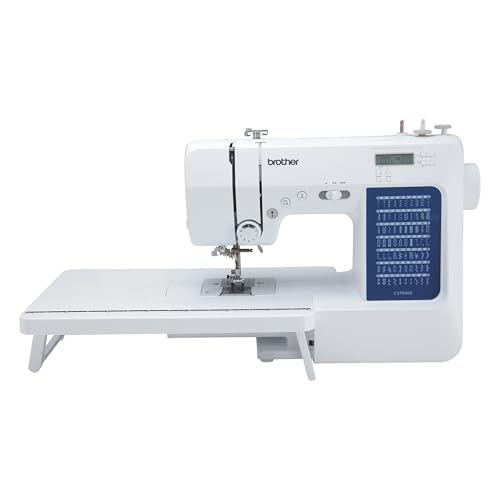 Brother CS7000X Computerized Sewing & Quilting Machine The first machine most beginners should buy | 70 built-in stitches | 9.2/10 | |
| 4 | No photo Walking foot (even feed foot) Quilts, knits and anything with layers that shift | The one foot worth buying first | 7.7/10 | Check price on Amazon #ad affiliate link · no live price for this item |
Mending and hemming on the smallest budget
Brother LX3817 Sewing Machine
The cheapest machine Brother lists here, and the one where the saving is visible: seventeen stitches, four presser feet, a four-step buttonhole and manual needle threading.
Skip this one
This is the cheap end of this comparison and we are naming it as the skip for anyone who is not certain their sewing will be limited to hems and repairs. The saving is real, and so is what it costs: manual needle threading, a four-step buttonhole and four presser feet. If there is any chance of a garment in your future, the next model up is the best-value move in this category.
The LX3817 is where the budget line genuinely bites, and it is worth being specific about how. Brother's specification page lists the needle threading system as manual. On the XM2701, fifty dollars higher, it is automatic. That one line is, in our view, the difference between a machine a beginner keeps using and one that gets put away — threading a needle by eye under a machine arm, at the end of a long day, is where a lot of first attempts end.
The buttonhole is the second cut. This machine sews a four-step auto-size buttonhole, which means moving the dial through four positions in the right order for each buttonhole. The XM2701 and the CS7000X sew a one-step buttonhole: place the button, press, done. If you are shortening trousers and taking in seams you will never notice. If you are making a shirt you will notice on the first placket.
What survives the cost-cutting is more interesting than what does not. It keeps the jam-resistant quick-set drop-in top bobbin — Brother has not fitted a front-loading case to save money — and it has an independent bobbin winding motor, so winding does not drive the needle. It has a free arm and an LED-lit work area. At 10.36 lb it is lighter than the XM2701.
The honest use case: this is a mending and hemming machine. If what you actually want is to take up jeans, fix a seam, and run a curtain hem twice a year, seventeen stitches and four feet is not a compromise, it is the correct amount of machine. If you think you might make a garment, the next machine up buys back the two features you will miss.
We have not sewn on this machine. Every specification above is from Brother's own product page, and the price on the button is live.
What works
- Brother lists it at $99.00, the lowest entry point in this line-up
- Keeps the jam-resistant drop-in bobbin, which is the more important of the two convenience features
- Independent bobbin winding motor, so winding a bobbin does not fight the needle drive
- Free arm for hems, cuffs and sleeves — the jobs most people buy a first machine for
- 10.36 lb, the second-lightest machine here
What does not
- Manual needle threading. Brother's own specification says so, and it is the single feature we would not give up
- A four-step buttonhole rather than a one-step, so every buttonhole is four dial positions you have to get right
- Four presser feet, with no overcasting or blind stitch foot
- Seventeen stitches runs out quickly once you move past mending
The kit it pairs with: Add a needle threader tool, a blind stitch foot and an overcasting foot if you intend to sew garments rather than mend them.
The cheapest machine that still threads itself
Brother XM2701 Sewing Machine
Brother's entry mechanical keeps the automatic needle threader and the drop-in bobbin and drops almost everything else — which is the right corner to cut if a first machine has to stay under the price of a computerized one.
The XM2701 is the machine that answers the question this site exists to answer: what is the least you can spend and still have a machine that does not make you give up? Brother's specification lists an automatic needle threading system and a jam-resistant quick-set top drop-in bobbin on a machine it lists at $149.99. Those two features are the difference between an evening of sewing and an evening of swearing, and most machines at this price drop at least one of them.
What you give up is breadth. Six presser feet — buttonhole, zipper, zigzag, narrow hemmer, blind stitch and button sewing — cover ordinary garment sewing and nothing beyond it. There is no walking foot, so quilting through batting will fight you, and no quarter-inch foot, so piecing accurately means marking or moving the needle. Both can be bought later; both cost money the CS7000X does not ask for.
Stitch selection is a dial and thread tension is manual. That is not a bad thing for learning. A dial has no menu to get lost in, and manual tension forces you to understand what tension actually does rather than trusting a machine to hide it from you. It is slower to get a perfect stitch and faster to understand why the stitch was wrong.
One number to take seriously: 12.6 lb. That is the heaviest machine in Brother's beginner line here — heavier than the CS7000X at 10.5 lb and the XR9550 at 10.14 lb — and there is no hard case. If the machine is going to live on a shelf and come down for each session, weigh that against the price saving.
We have not sewn on this machine. The specifications above are Brother's own, and the price on the button is live from Amazon.
What works
- Keeps the automatic needle threader — rare at this end of Brother's range
- Jam-resistant quick-set drop-in bobbin, the same system as machines costing far more
- A one-step buttonhole rather than a four-step one, which is a real difference the first time you sew a buttonhole
- 27 stitches is genuinely enough for a first year of sewing
- Brother publishes a 25-year limited warranty on it
What does not
- Six presser feet, and none of them is a walking foot or a quarter-inch foot
- No hard cover in the box, so it needs somewhere to live
- At 12.6 lb it is the heaviest of Brother's beginner machines here, which matters if it gets carried to a class
- Manual thread tension, so uneven stitches are a dial you have to learn rather than something the machine corrects
The kit it pairs with: Budget for a walking foot if you plan to quilt, and for a dust cover — neither is included.
The first machine most beginners should buy
Brother CS7000X Computerized Sewing & Quilting Machine
The only machine on this page that arrives with the two feet a beginner ends up buying anyway — a walking foot and a quarter-inch foot — plus an automatic needle threader and a drop-in bobbin, so the two jobs that make people quit are the two jobs it makes easy.
The CS7000X is the machine we point a first-time buyer at, and the reason has nothing to do with its stitch count. It is the presser feet. Brother lists ten of them in the box — zigzag, buttonhole, zipper, button sewing, overcasting, blind stitch, monogramming, quarter-inch, quilting and walking — plus a quilt guide. Two of those, the walking foot and the quarter-inch foot, are the exact accessories a beginner ends up ordering three months in, and they are not cheap bought separately.
The second reason is the threading. Brother's published specification lists an automatic needle threading system and a quick-set drop-in top bobbin. Threading the needle and setting the bobbin are the two jobs that make people put a machine back in its box, and this one turns both into a lever pull and a drop. On a front-loading machine you are removing a case, seating a bobbin in a particular orientation, and hoping.
It is a computerized machine, which means stitch selection is a mode key and a shift key against an LCD rather than a dial. That is a genuine trade-off, not a straight upgrade: a dial is legible at a glance and has nothing to fail, while an LCD tells you the stitch width and length the machine has actually selected. For someone learning, seeing the numbers is worth more than the simplicity of a dial.
The extras matter more than they sound. The detachable wide table turns a small free-arm machine into something you can push a quilt across, and the hard protective cover is the difference between a machine that stays out on a table and one that lives in a cupboard collecting dust. Brother also publishes a 25-year limited warranty and free phone and online technical support for the life of the product.
We have not sewn on this machine. Everything above is from Brother's own specification page, and the price on the button is live from Amazon rather than anything we typed. What we can tell you is what the box contains and what that saves you buying — which, for a first machine, is most of the decision.
What works
- Automatic needle threader and a drop-in bobbin — the two setup jobs that defeat most beginners
- Ten presser feet including the walking foot and a quilting foot, which the cheaper machines make you buy separately
- Detachable wide table and a hard cover are in the box, not extras
- Adjustable sewing speed control, so a first seam can be run slowly
- Brother publishes a 25-year limited warranty on it
What does not
- Seventy stitches is far more than a beginner will use; you are paying for decorative stitches you may never touch
- Computerized machines have more to go wrong electronically than a dial-and-lever mechanical
- At 10.5 lb it is light enough to walk across a table at speed unless it is on a firm surface
The kit it pairs with: It already includes the walking foot and quilting foot, so its starter kit is short: needles, bobbins, thread, shears and pins.
Quilts, knits and anything with layers that shift
Walking foot (even feed foot)
Feeds the top layer at the same rate the feed dogs move the bottom one — the single accessory that turns a rippling quilt sandwich into a flat one.
Every sewing machine has feed dogs — the little serrated bars that rise through the needle plate and pull the fabric backwards a stitch at a time. They only touch the bottom layer. When you sew two layers together, the bottom one is being actively pulled and the top one is being dragged along by friction, so the top layer travels a fraction less far on every stitch. Over a two-foot seam that fraction adds up to an inch, and that inch is why the ends do not line up.
A walking foot is a second set of feed dogs mounted in the presser foot, driven off the needle bar so they move in time with the ones underneath. Both layers get gripped and both travel the same distance. That is the entire idea, and it is why it fixes quilt sandwiches, wavy knit hems and plaids that refuse to match.
Where it matters most is quilting, because a quilt is three layers with a compressible one in the middle. Without a walking foot, batting compresses unevenly under the foot and squirts forward, and you finish a quilting line with a fold pushed up ahead of the needle.
Two buying notes. First, shank type: home machines are mostly low-shank, but not all, and a walking foot for the wrong shank will not sit at the right height. Your manual says which yours is. Second, this is the one accessory where the machine manufacturer's own version is usually worth the premium — a walking foot has moving parts, and a cheap one develops play that shows up as an uneven stitch.
Brother includes a walking foot with the CS7000X. It does not include one with the XM2701, the LX3817 or the XR9550, and Singer does not list one with the M1500 or the Heavy Duty 4423. If you are comparing prices between machines, this is the accessory that changes the arithmetic.
What works
- Solves the layer-shift problem mechanically, which no amount of pinning fully does
- Also the best fix for wavy hems on knit fabric
- Makes plaids and stripes match across a seam instead of drifting
- The Brother CS7000X includes one, which is a large part of why it is our top pick
What does not
- The most expensive common presser foot, and the one most often bought in the wrong shank type
- Bulky, noisy and slow — it is not a foot to leave on for ordinary seams
- Generic 'universal' walking feet vary in quality; the machine maker's own is the safer buy
Compiled from Brother USA specification pages, 1 September 2026. Three machines from the same manufacturer's beginner range, so the comparison is like for like.
Step one: the needle threader and the buttonhole
The first step up buys exactly two things, and both of them are things you interact with constantly.
Automatic needle threading. Brother lists the LX3817 as manual and the XM2701 as automatic. You re-thread every time you change color, break a thread or change a needle — many times an evening on a real project. Threading by eye under a machine arm is the specific, unglamorous friction that stops people sewing.
A one-step buttonhole. Four-step means moving the dial through four positions in order and judging the length of each side yourself; making two buttonholes match takes practice. One-step means dropping the button in the foot and pressing the pedal.
Everything else at that first step — ten more stitches, two more presser feet — is marginal. Those two features are the purchase.
Step two: the accessories
The second step up is almost entirely about what is in the box. The CS7000X adds four more presser feet including a walking foot and a quarter-inch foot, a detachable wide table, a hard protective cover and adjustable sewing speed control, plus forty-three more stitches and six more buttonhole styles.
Here is the arithmetic that matters: if you bought the XM2701 and then bought a walking foot and a quarter-inch foot separately, you would close a good part of the price gap — and still have no wide table, no hard cover and no speed control. That is the case for the second step, and it only applies if you actually want those feet.
What more money does not buy
A stronger motor. None of these three publishes a motor rating, and none is described as heavy-duty. If thick fabric is the problem, the answer is a machine with adjustable presser foot pressure and a metal frame — the SINGER Heavy Duty 4423 — not a more expensive Brother.
A lighter machine. The cheapest machine here weighs 10.36 lb and the mid one weighs 12.6 lb. Price and weight are unrelated.
Durability, as far as anyone publishes. Brother lists a 25-year limited warranty on the XM2701 and the CS7000X and a 1/2/25-year limited warranty on the LX3817. We are not going to infer a lifespan from a warranty document and neither should anyone else.
The verdict
Take the first step up. Always. The automatic threader and the one-step buttonhole are the two features whose absence beginners actually complain about, and the price difference is the smallest on this page.
Take the second step only if you want the feet. If you will quilt, the walking foot and quarter-inch foot make it worth it outright. If you will make clothes, look at the XR9550 instead for the buttonhole styles. If you will hem and mend, stop at the first step and spend the difference on fabric.
Method
How we picked
- Put both sides' published manufacturer specifications side by side — Brother USA, SINGER and SCHMETZ pages, all checked 1 September 2026 — rather than comparing impressions.
- Resolved each dimension separately and said which side wins it, instead of averaging everything into a tie.
- Named a winner, and named the buyer the other option is right for.
- Priced live from Amazon. No number on this page is remembered.
We have not sewn on these machines. There is no test bench here, we do not own them, and we do not accept free product. Everything above is compiled from published manufacturer specifications and live retailer data — and we tell you which is which on every claim. Our full method.
Answers
Questions people ask
Is it worth paying more for a sewing machine?
What is the difference between a cheap and an expensive sewing machine?
Do expensive sewing machines last longer?
What should I upgrade to if I outgrow a cheap machine?
Where this came from
Sources
About the author
Scooter M.
An enthusiast who is genuinely into this. I read the manuals, compile the published specs, and do the arithmetic. No lab coat, no test bench, and no machines I am pretending to have used — which is exactly why every claim here carries a source.
Published by Slate Mill Group. Published September 1, 2026; last updated September 1, 2026. Editorial policy.
Keep reading
Read next
The honest answer
Are cheap sewing machines worth it?
Where the line falls between a bargain and a machine you will fight — three specifications, not a price.
Best entry tier
The best sewing machines under $200
The entry tier, ranked on what the band structurally buys — and the one machine to think twice about.
Best for mending only
Brother LX3817 review: a good mending machine, and no more than that
Seventeen stitches, four feet and manual needle threading — genuinely the right machine for hems and repairs, and the wrong one for garments.
Best value mechanical
Brother XM2701 review: the cheapest machine that still threads its own needle
27 stitches, an automatic needle threader and a jam-resistant drop-in bobbin — the value pick of the mechanical machines.