Stitch & Selvage earns a commission when you buy through the links on this page, at no extra cost to you. It does not change what we recommend, and we publish a skip-this verdict on products we could otherwise earn from. Full disclosure.
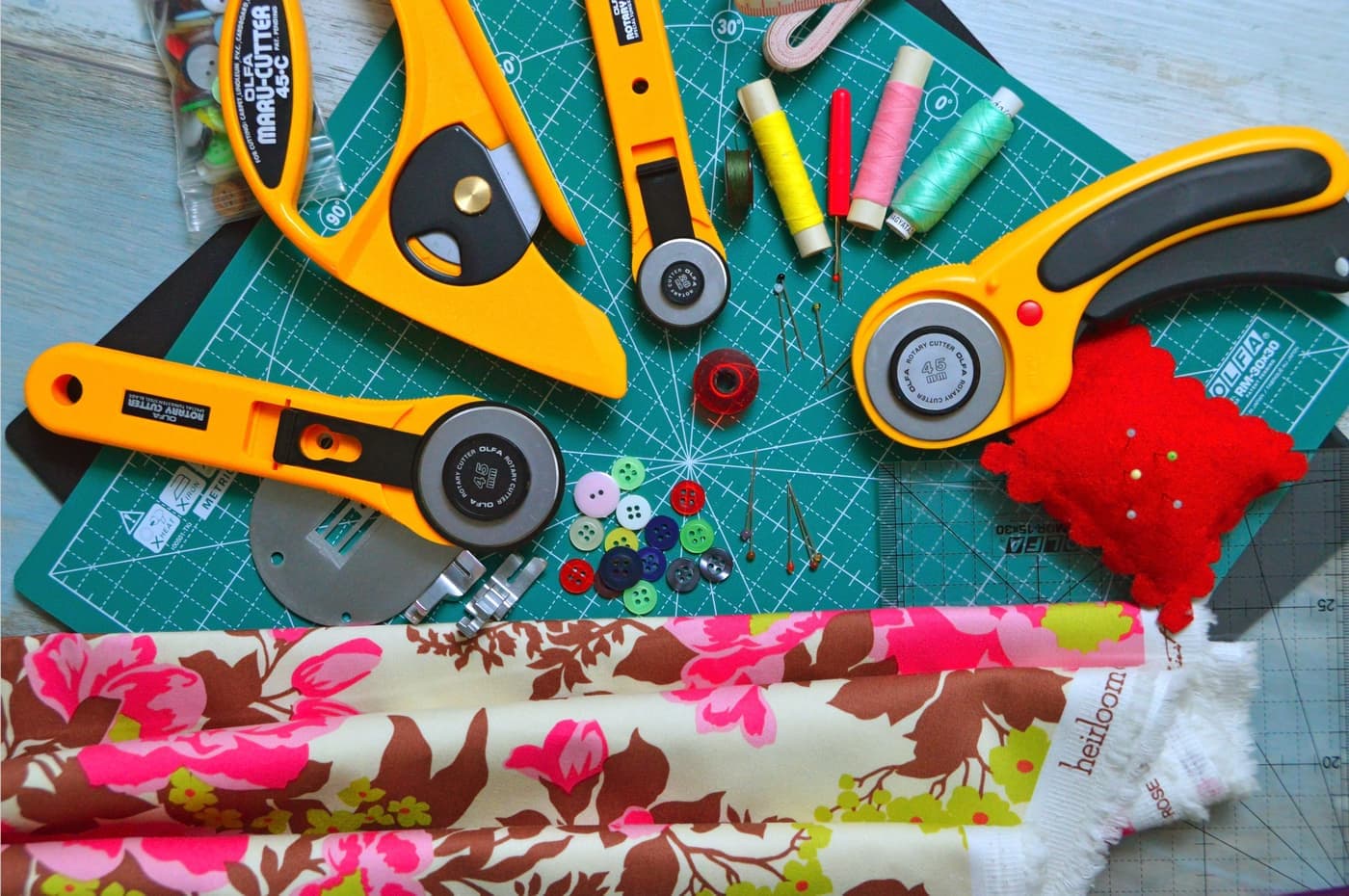
Quilting's kit differs from garment sewing in one big way: cutting. A rotary cutter, a self-healing mat and a quilting ruler replace shears, because quilting depends on cutting many identical straight-edged pieces and shears cannot do that accurately. Everything else is the machine accessories you already know about.
The cutting kit, which is not optional
This is the one place we would tell a beginner quilter to spend before anything else, and it is the part garment sewers are surprised by.
A rotary cutter. A circular blade in a handle that rolls along a ruler edge. It cuts through several layers at once, follows a straight edge exactly, and does not lift the fabric as it cuts — which is what makes shears wander. Get one with a retracting guard, because the blade is genuinely sharp.
A self-healing cutting mat. The surface the cutter runs on. Its material closes behind the blade so the mat does not develop grooves that steer later cuts. Get the largest that fits your table; the common first size is around 18 by 24 inches.
A quilting ruler. Thick clear acrylic, marked with a grid, and thick enough that the rotary blade rides against its edge without climbing over it. A 6 by 24 inch ruler is the standard first purchase because it spans a folded width of fabric.
Those three together are why quilt blocks come out square. Cutting accuracy matters more than sewing accuracy in quilting — two pieces that were never the same size cannot be rescued by careful stitching.
The machine accessories
A walking foot, for quilting the layers together. Brother includes one with the CS7000X and no other machine we cover includes one. Why it matters.
A quarter-inch foot, for piecing, unless your machine has a needle position key — the XR9550 does. Every quilt pattern is calculated from a quarter-inch seam allowance and the error compounds across every seam.
Quilting needles, 75/11 for piecing and 90/14 for quilting through batting. SCHMETZ specifies 'a special taper to shaft and slightly rounded point to prevent damage to material sewn in layers'.
A wide table, if your machine did not include one. Brother includes a detachable wide table with the CS7000X and the XR9550. Without one the quilt hangs off the free arm and its weight drags your stitching line off course.
The ranking
Quick picks
Ranked against the published criteria below. Tap a row to jump to the full write-up; the price button goes straight to Amazon.
| # | Product | Best for | Score | Price |
|---|---|---|---|---|
| 1 |  Quilting needles, 75/11 and 90/14 Piecing and quilting through batting | Sizes 75/11 and 90/14 | 6.7/10 | $17.69 on Amazon #ad affiliate link · price as of October 17, 2026 |
| 2 | No photo Walking foot (even feed foot) Quilts, knits and anything with layers that shift | The one foot worth buying first | 7.7/10 | Check price on Amazon #ad affiliate link · no live price for this item |
| 3 | No photo Quarter-inch (piecing) foot Quilt blocks that come out the right size | The accuracy foot | 7.5/10 | Check price on Amazon #ad affiliate link · no live price for this item |
| 4 | No photo The 100-piece bargain sewing accessory kit Nothing we can recommend Our skip-this pick | Our skip-this pick | 2.8/10 | Check price on Amazon #ad affiliate link · no live price for this item |
Piecing and quilting through batting
Quilting needles, 75/11 and 90/14
A tapered shaft and a slightly rounded point designed not to damage layered material — the needle for the moment a quilt stops being two pieces of cotton and becomes a sandwich.
SCHMETZ describes the quilting needle as having a 'special taper to shaft and slightly rounded point to prevent damage to material sewn in layers'. Both halves of that sentence are doing work.
The taper first. When you quilt, the needle is not going through one thickness of cotton — it is going through a top, batting, a backing, and wherever seams cross, four or six thicknesses of pieced seam allowance. A parallel-sided needle drags all of that with it. A tapered shaft narrows behind the point, so the hole it makes closes behind it and the layers stay put rather than being pushed down into the needle plate.
The rounded point is the same logic as the ball point on a universal needle, applied to a different problem: quilting cotton is finely woven and a sharp point cuts fibers. Over a whole quilt, thousands of cut fibers is a visibly weaker seam.
Two sizes cover it. Use 75/11 for piecing flat blocks, where you want the smallest hole possible, and 90/14 once the batting is in. If you are quilting something heavy — a denim quilt, or a top with dense wadding — SCHMETZ's denim needle is the better tool, because at that point stiffness matters more than taper.
What works
- The tapered shaft is what lets it pass through pieced seam allowances without pushing the layers apart
- Sold in exactly two useful sizes, so there is no decision to get wrong
- Cheaper than the walking foot people buy first for the same problem
What does not
- Only two sizes published, so heavy quilts with dense batting may still want a denim needle
- Solves the needle problem, not the feeding problem — a walking foot is the other half
- Unnecessary for flat piecing on quilting cotton, where an 80/12 universal is fine
Quilts, knits and anything with layers that shift
Walking foot (even feed foot)
Feeds the top layer at the same rate the feed dogs move the bottom one — the single accessory that turns a rippling quilt sandwich into a flat one.
Every sewing machine has feed dogs — the little serrated bars that rise through the needle plate and pull the fabric backwards a stitch at a time. They only touch the bottom layer. When you sew two layers together, the bottom one is being actively pulled and the top one is being dragged along by friction, so the top layer travels a fraction less far on every stitch. Over a two-foot seam that fraction adds up to an inch, and that inch is why the ends do not line up.
A walking foot is a second set of feed dogs mounted in the presser foot, driven off the needle bar so they move in time with the ones underneath. Both layers get gripped and both travel the same distance. That is the entire idea, and it is why it fixes quilt sandwiches, wavy knit hems and plaids that refuse to match.
Where it matters most is quilting, because a quilt is three layers with a compressible one in the middle. Without a walking foot, batting compresses unevenly under the foot and squirts forward, and you finish a quilting line with a fold pushed up ahead of the needle.
Two buying notes. First, shank type: home machines are mostly low-shank, but not all, and a walking foot for the wrong shank will not sit at the right height. Your manual says which yours is. Second, this is the one accessory where the machine manufacturer's own version is usually worth the premium — a walking foot has moving parts, and a cheap one develops play that shows up as an uneven stitch.
Brother includes a walking foot with the CS7000X. It does not include one with the XM2701, the LX3817 or the XR9550, and Singer does not list one with the M1500 or the Heavy Duty 4423. If you are comparing prices between machines, this is the accessory that changes the arithmetic.
What works
- Solves the layer-shift problem mechanically, which no amount of pinning fully does
- Also the best fix for wavy hems on knit fabric
- Makes plaids and stripes match across a seam instead of drifting
- The Brother CS7000X includes one, which is a large part of why it is our top pick
What does not
- The most expensive common presser foot, and the one most often bought in the wrong shank type
- Bulky, noisy and slow — it is not a foot to leave on for ordinary seams
- Generic 'universal' walking feet vary in quality; the machine maker's own is the safer buy
Quilt blocks that come out the right size
Quarter-inch (piecing) foot
Quilting is built on a quarter-inch seam allowance, and this foot makes it a physical edge to follow instead of a line you are trying to eyeball.
Almost every quilting pattern ever written assumes a quarter-inch seam allowance. That is not a style choice, it is a unit: block sizes, sashing widths and final quilt dimensions are all calculated from it. Sew at five-sixteenths instead and every block finishes small, and the error compounds with every seam.
A quarter-inch foot solves it by geometry. The foot is manufactured so that its right-hand edge, or a small metal flange on it, sits exactly a quarter inch from the needle. You align the raw edge of the fabric with that edge and stop thinking about it. Accuracy becomes a matter of feeding straight rather than of judging distance.
There is a free alternative on some machines. Brother lists a needle position key on the XR9550: instead of moving the guide to the needle, you move the needle relative to the standard foot edge, then measure once and note the setting. It takes five minutes to calibrate and costs nothing. Machines without that key — the XM2701, the LX3817, the M1500 — need the foot.
Brother includes a 1/4 in foot with the CS7000X. None of the other machines on this site includes one. If quilting is why you are buying a machine, that is worth about the price of two feet in the comparison.
What works
- Turns an accuracy problem into a mechanical one — you follow an edge instead of watching a mark
- Errors in piecing compound: a sixteenth of an inch out over twelve seams is three-quarters of an inch of finished block
- Cheap, small, and it is the foot quilting patterns assume you own
What does not
- Useless outside quilting and precise piecing
- Versions with a metal flange can catch on thick seam allowances
- If your machine has a needle position key you can achieve the same result without buying anything
Nothing we can recommend
The 100-piece bargain sewing accessory kit
Most of what is in a mega-kit is already in the box your machine came in, and the parts that are not are the parts that need to fit your specific machine.
Skip this one
This is our skip-this pick, and it is a skip on every page it appears. Read the carton contents Brother and Singer publish for your machine before you buy an accessory kit: both makers already include needles, bobbins, a seam ripper, a screwdriver, a cleaning brush and spool pins. What a mega-kit adds on top is mostly duplicates plus parts whose fit depends on your machine's bobbin class and presser foot shank, neither of which a generic kit can guarantee. Buy the specific things your machine did not come with instead.
Every roundup on this site carries one pick we tell you not to buy. This is it, and it is here because it is the most commonly bought wrong thing in the category — the reflex purchase a new owner makes on the same order as the machine.
Start with what is already in your box, because the manufacturers publish it. Brother lists the CS7000X carton as containing ten sewing feet, a quilt guide, an accessory pouch with a needle set, a ball point needle, a twin needle, a spool pin, three bobbins, a cleaning brush, a seam ripper, a screwdriver, an eyelet punch, an L driver, the operation manual, a hard protective cover and a wide table. The XM2701 ships with a darning plate, an accessory bag with a needle pack, a twin needle, a screwdriver, an extra spool pin, three bobbins and the power cord. Singer lists the M1500's included accessories as an all-purpose foot, a zipper foot, a buttonhole foot, a darning plate, a pack of needles, Class 15 bobbins, a needle plate, a screwdriver, spool pin felt and a seam ripper / lint brush.
Now compare that to a 100-piece kit's contents list. Needles, bobbins, a seam ripper, a screwdriver, a brush, spool pins, a threader, a tape measure. You own all of it. What you are paying for is duplicates, and duplicates of the cheapest items in the category.
Worse, the two categories where a generic kit could add value are the two where fit is not guaranteed. Bobbins have a class — Singer specifies Class 15 transparent for both of its machines here and recommends its own or INSPIRA-branded bobbins for best results. A bobbin of the wrong class or the wrong material seats badly and produces the loops-under-the-fabric problem that sends people looking for a repair shop. Presser feet have a shank type, low or high, and a foot for the wrong shank sits at the wrong height.
The genuinely useful spend, for the same money or less, is short and specific: a walking foot if you will quilt, a quarter-inch foot if you will piece, a second pack of universal needles, a handful of the correct bobbins for your machine, and a cover if your machine did not come with one. That is what our starter-kit roundup is made of, and there is a reason none of it comes in a hundred-piece bag.
What works
- Genuinely cheap per item, if the items happened to fit
- The one honest use: a spare set for a second machine you already know the fit of
What does not
- You already own most of it. Brother and Singer both ship needles, bobbins, a seam ripper, a screwdriver and a brush in the carton
- Bobbins in a generic kit may not be your machine's class, and an out-of-spec bobbin causes exactly the thread-bunching people blame the machine for
- Presser feet in a generic kit may be the wrong shank type
- The two feet worth owning — a walking foot and a quarter-inch foot — are almost never the ones included
- Buying it delays buying the things that would actually help
The notions
- Curved safety pins for basting the three layers together. The curve lets you pick up all three layers and come back out in one motion without lifting the quilt off the table. Spray basting adhesive is the faster alternative.
- Quilting cotton, which is the fabric itself. It is stable, presses crisply and is woven at a weight that suits piecing.
- Batting — the padded middle layer. Cotton batting is traditional and presses flat; polyester is loftier and cheaper. For a first quilt either is fine; choose one with a stated maximum quilting distance and stay within it.
- A seam roller or a good iron. Pressing every seam before crossing it is what keeps a pieced block flat.
- Marking tools — chalk or a water-soluble marker — for quilting lines. Test on scrap first that it actually comes out.
What can wait
Quilting attracts equipment, and almost none of it is needed for a first quilt.
- Specialty rulers — half-square triangle rulers, hexagon templates, curved rulers. Every one solves a specific block you have not made yet.
- A quarter-inch foot with a guide flange, if you already have a plain quarter-inch foot. The flange helps and it also catches on thick seam allowances.
- A design wall. Useful, and a photo on your phone does the same job for nothing.
- A stitch regulator or a long-arm machine. These are genuine upgrades for someone who quilts regularly and they are a long way past quilt number one.
- A hundred-piece accessory kit. Still the wrong purchase, still mostly duplicates of what your machine already came with.
A word on fabric quantity
Buy more backing fabric than the top's dimensions suggest. The backing and the batting should each be about four inches larger than the top on every side, because the layers shift as you quilt and you need the margin to trim square at the end. Running out of backing halfway through basting is a genuinely common first-quilt problem.
When you have the kit, here is the first quilt to make with it.
Answers
Questions people ask
What supplies do I need to start quilting?
Do I need a rotary cutter for quilting?
What size cutting mat should I buy?
What is batting?
How much backing fabric do I need?
Where this came from
Sources
- SCHMETZ — Sewing Machine Needle Primer, quilting needle description and sizes (checked 1 September 2026)
- Brother USA — CS7000X included feet, walking foot, quarter-inch foot, quilt guide and wide table (checked 1 September 2026)
- Brother USA — XR9550 included feet and needle position key (checked 1 September 2026)
About the author
Scooter M.
An enthusiast who is genuinely into this. I read the manuals, compile the published specs, and do the arithmetic. No lab coat, no test bench, and no machines I am pretending to have used — which is exactly why every claim here carries a source.
Published by Slate Mill Group. Published September 1, 2026; last updated September 1, 2026. Editorial policy.
Keep reading
Read next
First quilt
Your first quilt project
A baby or lap quilt in squares — the size a domestic machine can actually handle, and the seam that decides it.
Best for quilting
The best sewing machines for quilting beginners
The three specifications that decide quilting, and the two machines plus three accessories that satisfy them.
Walking foot
What a walking foot actually does
The one-sentence explanation, the four jobs it fixes, and which machines include one in the box.
Quilting vs regular
Quilting machine or regular sewing machine?
Four features make a machine a quilting machine, and three of them can be bought as accessories.