Stitch & Selvage earns a commission when you buy through the links on this page, at no extra cost to you. It does not change what we recommend, and we publish a skip-this verdict on products we could otherwise earn from. Full disclosure.
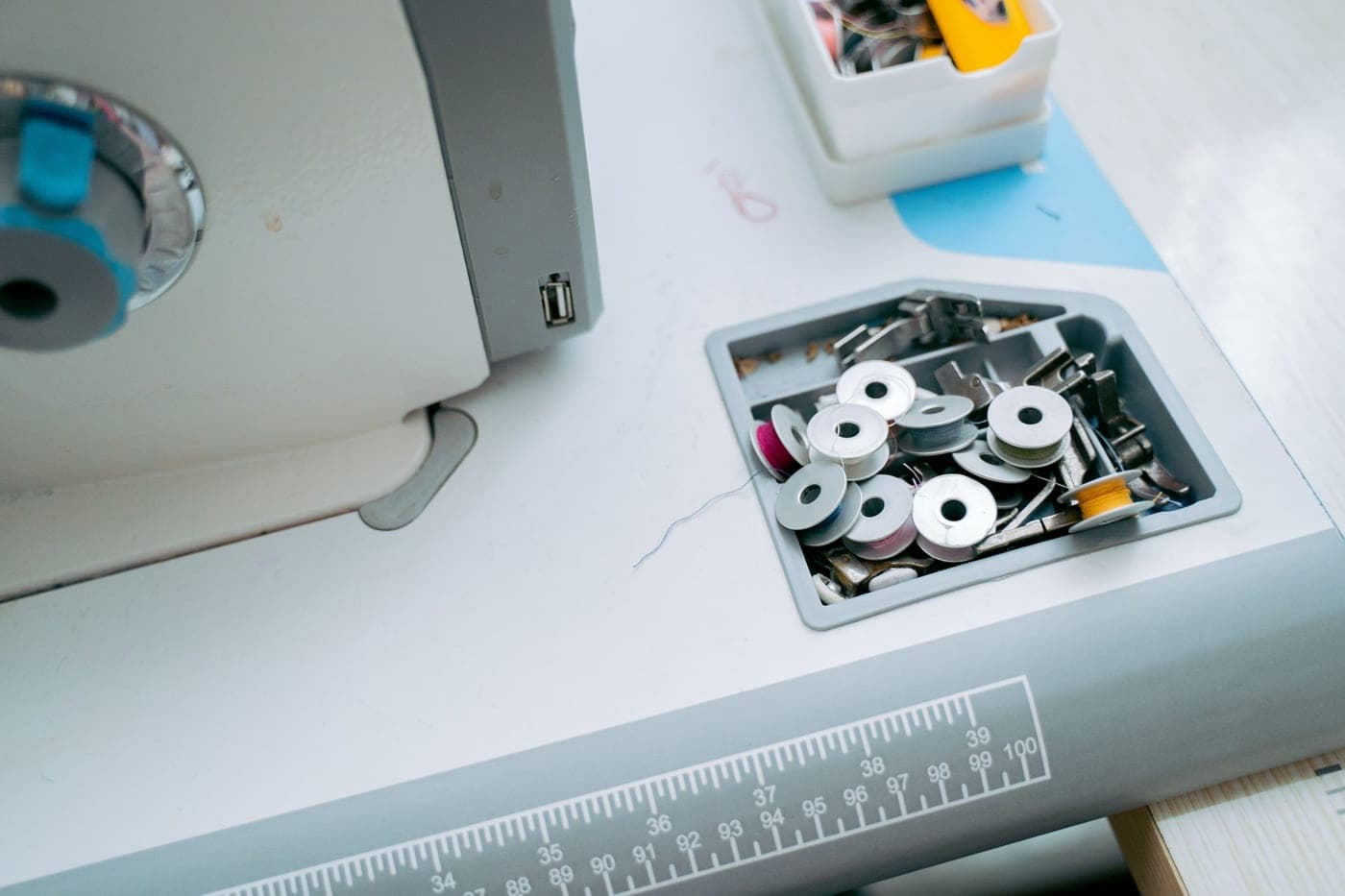
Buy a bundle for the consumables — pins, tape measure, chalk, thread snips — and buy the machine-specific parts yourself: bobbins in your machine's class, needles matched to your fabric, and any presser foot, matched to your machine's shank type. Those are the two parts a generic kit cannot get right.
The ranking
Quick picks
Ranked against the published criteria below. Tap a row to jump to the full write-up; the price button goes straight to Amazon.
| # | Product | Best for | Score | Price |
|---|---|---|---|---|
| 1 |  Universal machine needles, 80/12 and 90/14 The needle you should already own two packs of | Sizes 60/8 to 120/19 | 9.3/10 | $19.95 on Amazon #ad affiliate link · price as of October 17, 2026 |
| 2 |  Class 15 transparent bobbins Not stopping mid-seam to wind another one | Class 15, transparent | 8.9/10 | $14.83 on Amazon #ad affiliate link · price as of October 17, 2026 |
| 3 | No photo Walking foot (even feed foot) Quilts, knits and anything with layers that shift | The one foot worth buying first | 7.7/10 | Check price on Amazon #ad affiliate link · no live price for this item |
| 4 | No photo The 100-piece bargain sewing accessory kit Nothing we can recommend Our skip-this pick | Our skip-this pick | 2.8/10 | Check price on Amazon #ad affiliate link · no live price for this item |
The needle you should already own two packs of
Universal machine needles, 80/12 and 90/14
A slight ball point that sews both knit and woven fabric, which is why it is the only needle a first project actually requires — and the one most people never replace often enough.
SCHMETZ describes the universal needle in seven words: 'General sewing of knit and woven fabrics. Slight ball point.' That slight ball point is the whole design. A perfectly sharp point pierces the yarns of a woven cloth cleanly and cuts through the loops of a knit, causing runs. A full ball point pushes knit loops aside but struggles to pierce a dense woven. The universal splits the difference, badly enough that a specialist needle beats it on any one fabric, and well enough that it is the only needle a first project needs.
Buy sizes 80/12 and 90/14, and understand what the two numbers mean: they are the same measurement in two systems, metric (NM) and imperial (Singer). An 80/12 is 0.8 mm across the blade. Lighter fabric wants a smaller number; heavier fabric wants a bigger one. Quilting cotton and shirting sew happily on an 80/12. Denim-weight woven, canvas and multiple layers want a 90/14.
The mistake almost every beginner makes is not buying the wrong needle, it is keeping the right one too long. A needle blunts from the friction of passing through fabric thousands of times, and a blunt needle is a leading cause of skipped stitches, snagged fabric and thread that keeps breaking — the exact symptoms people diagnose as a broken machine. Change it when you start a significant project, and change it after roughly eight hours of sewing.
SCHMETZ publishes universal needles from 60/8 up to 120/19, plus assorted packs, twin needles and triple needles. An assorted pack is the right first purchase because it lets you find out which size your fabric actually likes without buying five packs.
What works
- Sews knit and woven fabric acceptably, which no other needle type does
- The widest size range SCHMETZ publishes for any home needle — 60/8 through 120/19
- An assorted pack covers a beginner's first year of fabrics for the price of a coffee
- Sold as a twin and a triple needle for hems and decorative topstitching
What does not
- A compromise by design — for a stretchy knit a jersey needle skips fewer stitches, and for heavy denim a denim needle deflects less
- Blunts long before it looks blunt; a needle that has sewn eight hours is due for replacement
- Twin needles are not compatible with every stitch on every machine — check your manual first
Not stopping mid-seam to wind another one
Class 15 transparent bobbins
Both Singer machines on this site take a Class 15 transparent bobbin, and three is not enough — a transparent bobbin also lets you see the thread running out before it does.
Start with the warning, because it is the one that costs people an evening: bobbin class is not universal, and a nearly-right bobbin is worse than no bobbin. A bobbin that is fractionally too tall, too wide or made of the wrong material will sit at a slight angle in the case, feed thread unevenly, and produce exactly the nest of loops underneath your fabric that people diagnose as a broken machine. Singer publishes the bobbin class for both machines on this site as Class 15 transparent, and recommends SINGER or INSPIRA branded bobbins for best results. Your manual states yours.
Assuming you have the right class, the reason to buy more is simple arithmetic. Brother ships three bobbins with the CS7000X, the XM2701 and the LX3817, and four with the XR9550. A single garment in two thread colors plus a basting color uses three. The moment you run out mid-seam you have to unthread the machine, wind a bobbin, and re-thread — and re-threading is where the next problem starts.
Transparent rather than metal, for a beginner, for one reason: you can see how much thread is left. Running the bobbin dry in the middle of a topstitch line is a specific kind of annoying, because the top thread keeps stitching and you do not notice until you turn the work over.
Wind one bobbin per color you use regularly and keep them on a bobbin ring. It is the cheapest quality-of-life improvement in this whole list.
What works
- Transparent, so you can see the thread level without unthreading the machine
- Cheap enough to wind one per thread color and stop re-winding
- Class 15 is the most widely used home bobbin class, so replacements are easy to find
What does not
- Bobbin class is not universal. Check your manual — the wrong class will seat badly and cause bunching, and some machines specify a plastic or a metal bobbin, not both
- Singer explicitly recommends its own or INSPIRA-branded bobbins for best results
- A cheap out-of-spec bobbin is a common cause of the tension problems people blame on their machine
Quilts, knits and anything with layers that shift
Walking foot (even feed foot)
Feeds the top layer at the same rate the feed dogs move the bottom one — the single accessory that turns a rippling quilt sandwich into a flat one.
Every sewing machine has feed dogs — the little serrated bars that rise through the needle plate and pull the fabric backwards a stitch at a time. They only touch the bottom layer. When you sew two layers together, the bottom one is being actively pulled and the top one is being dragged along by friction, so the top layer travels a fraction less far on every stitch. Over a two-foot seam that fraction adds up to an inch, and that inch is why the ends do not line up.
A walking foot is a second set of feed dogs mounted in the presser foot, driven off the needle bar so they move in time with the ones underneath. Both layers get gripped and both travel the same distance. That is the entire idea, and it is why it fixes quilt sandwiches, wavy knit hems and plaids that refuse to match.
Where it matters most is quilting, because a quilt is three layers with a compressible one in the middle. Without a walking foot, batting compresses unevenly under the foot and squirts forward, and you finish a quilting line with a fold pushed up ahead of the needle.
Two buying notes. First, shank type: home machines are mostly low-shank, but not all, and a walking foot for the wrong shank will not sit at the right height. Your manual says which yours is. Second, this is the one accessory where the machine manufacturer's own version is usually worth the premium — a walking foot has moving parts, and a cheap one develops play that shows up as an uneven stitch.
Brother includes a walking foot with the CS7000X. It does not include one with the XM2701, the LX3817 or the XR9550, and Singer does not list one with the M1500 or the Heavy Duty 4423. If you are comparing prices between machines, this is the accessory that changes the arithmetic.
What works
- Solves the layer-shift problem mechanically, which no amount of pinning fully does
- Also the best fix for wavy hems on knit fabric
- Makes plaids and stripes match across a seam instead of drifting
- The Brother CS7000X includes one, which is a large part of why it is our top pick
What does not
- The most expensive common presser foot, and the one most often bought in the wrong shank type
- Bulky, noisy and slow — it is not a foot to leave on for ordinary seams
- Generic 'universal' walking feet vary in quality; the machine maker's own is the safer buy
Nothing we can recommend
The 100-piece bargain sewing accessory kit
Most of what is in a mega-kit is already in the box your machine came in, and the parts that are not are the parts that need to fit your specific machine.
Skip this one
This is our skip-this pick, and it is a skip on every page it appears. Read the carton contents Brother and Singer publish for your machine before you buy an accessory kit: both makers already include needles, bobbins, a seam ripper, a screwdriver, a cleaning brush and spool pins. What a mega-kit adds on top is mostly duplicates plus parts whose fit depends on your machine's bobbin class and presser foot shank, neither of which a generic kit can guarantee. Buy the specific things your machine did not come with instead.
Every roundup on this site carries one pick we tell you not to buy. This is it, and it is here because it is the most commonly bought wrong thing in the category — the reflex purchase a new owner makes on the same order as the machine.
Start with what is already in your box, because the manufacturers publish it. Brother lists the CS7000X carton as containing ten sewing feet, a quilt guide, an accessory pouch with a needle set, a ball point needle, a twin needle, a spool pin, three bobbins, a cleaning brush, a seam ripper, a screwdriver, an eyelet punch, an L driver, the operation manual, a hard protective cover and a wide table. The XM2701 ships with a darning plate, an accessory bag with a needle pack, a twin needle, a screwdriver, an extra spool pin, three bobbins and the power cord. Singer lists the M1500's included accessories as an all-purpose foot, a zipper foot, a buttonhole foot, a darning plate, a pack of needles, Class 15 bobbins, a needle plate, a screwdriver, spool pin felt and a seam ripper / lint brush.
Now compare that to a 100-piece kit's contents list. Needles, bobbins, a seam ripper, a screwdriver, a brush, spool pins, a threader, a tape measure. You own all of it. What you are paying for is duplicates, and duplicates of the cheapest items in the category.
Worse, the two categories where a generic kit could add value are the two where fit is not guaranteed. Bobbins have a class — Singer specifies Class 15 transparent for both of its machines here and recommends its own or INSPIRA-branded bobbins for best results. A bobbin of the wrong class or the wrong material seats badly and produces the loops-under-the-fabric problem that sends people looking for a repair shop. Presser feet have a shank type, low or high, and a foot for the wrong shank sits at the wrong height.
The genuinely useful spend, for the same money or less, is short and specific: a walking foot if you will quilt, a quarter-inch foot if you will piece, a second pack of universal needles, a handful of the correct bobbins for your machine, and a cover if your machine did not come with one. That is what our starter-kit roundup is made of, and there is a reason none of it comes in a hundred-piece bag.
What works
- Genuinely cheap per item, if the items happened to fit
- The one honest use: a spare set for a second machine you already know the fit of
What does not
- You already own most of it. Brother and Singer both ship needles, bobbins, a seam ripper, a screwdriver and a brush in the carton
- Bobbins in a generic kit may not be your machine's class, and an out-of-spec bobbin causes exactly the thread-bunching people blame the machine for
- Presser feet in a generic kit may be the wrong shank type
- The two feet worth owning — a walking foot and a quarter-inch foot — are almost never the ones included
- Buying it delays buying the things that would actually help
Check this before you buy anything
Both Brother and SINGER publish the exact carton contents for every machine on their product pages. Read yours. Here is what you will find.
Carton contents as published by Brother USA and SINGER, 1 September 2026.
Now compare that list against the contents of a typical accessory bundle: needles, bobbins, a seam ripper, a screwdriver, a cleaning brush, spool pins, a threader, a tape measure. Almost every item is a duplicate.
The case for the bundle
It is real and we are not going to pretend it is not. A beginner facing a wall of notions with no idea which of six kinds of pin to buy will frequently buy nothing at all, and a kit that puts the basics in one box gets them sewing this week. There is genuine value in a decision being made for you.
Bundles are also fair value on pure consumables where the specification does not matter much — pins, a tape measure, tailor's chalk, safety pins, a pin cushion. Researching those individually costs more time than the money it saves.
The case against, in two specifics
Bobbin class. Singer publishes Class 15 transparent for both machines we cover and recommends SINGER or INSPIRA-branded bobbins for best results. A bobbin that is fractionally the wrong size or material sits at an angle in the case and feeds thread unevenly, which produces the nest of loops under the fabric that beginners take to a repair shop. A bag of assorted bobbins is a coin toss on the one component where being nearly right is worse than being absent.
Presser foot shank. Most domestic machines are low-shank, but not all. A foot for the wrong shank sits at the wrong height, changing the pressure on the fabric and therefore the stitch. And the feet a bundle includes are almost never the two worth owning — a walking foot and a quarter-inch foot.
The arithmetic, done honestly
We do not print prices here, because every price on this site comes live from Amazon rather than from memory. But the shape of the arithmetic is stable regardless of what the numbers do.
A hundred-piece bundle is priced against the *count* of items in it. Perhaps two-thirds of those items are already in your machine's carton and another handful are things you will never use. So the honest comparison is not 'bundle price versus buying a hundred things', it is 'bundle price versus buying the six things you are actually missing' — and the six things are usually needles, bobbins, thread, shears, pins and one presser foot.
On that comparison, buying separately usually wins on money and always wins on fit. Where the bundle wins is on time and on decision fatigue, which for some people is worth more.
The verdict
Split it. Let a kit supply pins, a tape measure, chalk and thread snips. Buy your bobbins against your manual's stated class, your needles against the fabric you are actually going to sew, and any presser foot against your machine's shank type. That is three deliberate purchases and one lazy one, which is about the right ratio.
Our starter kit roundup is organized exactly that way — around what each specific machine did not include.
Method
How we picked
- Put both sides' published manufacturer specifications side by side — Brother USA, SINGER and SCHMETZ pages, all checked 1 September 2026 — rather than comparing impressions.
- Resolved each dimension separately and said which side wins it, instead of averaging everything into a tie.
- Named a winner, and named the buyer the other option is right for.
- Priced live from Amazon. No number on this page is remembered.
We have not sewn on these machines. There is no test bench here, we do not own them, and we do not accept free product. Everything above is compiled from published manufacturer specifications and live retailer data — and we tell you which is which on every claim. Our full method.
Answers
Questions people ask
Should I buy a sewing starter kit or buy pieces separately?
Are 100-piece sewing accessory kits a good deal?
What does my sewing machine already come with?
Which bobbins fit my machine?
Where this came from
Sources
About the author
Scooter M.
An enthusiast who is genuinely into this. I read the manuals, compile the published specs, and do the arithmetic. No lab coat, no test bench, and no machines I am pretending to have used — which is exactly why every claim here carries a source.
Published by Slate Mill Group. Published September 1, 2026; last updated September 1, 2026. Editorial policy.
Keep reading
Read next
Best starter kit
The sewing machine starter kit, built from what your machine did not include
Built backwards from the carton contents the manufacturers publish, so you buy the gaps rather than duplicates.
Best beginner kit
Beginner sewing kits: what a bundle gets right, and what it always misses
What a pre-built bundle genuinely saves you, what it always leaves out, and the bundle we tell you to avoid.
The checklist
What you actually need to start sewing
Must-have, can-wait and skip — with the items your machine already includes removed from the list.
The cost guide
What it actually costs to start sewing
The signature guide: machine plus kit equals total, at three budgets, with your carton contents subtracted first.